Kathmandu Class 9 English Beehive Chapter 10 Summary, Question Answers and Notes
Complete notes, summary, NCERT question answers, extra questions, and grammar exercises for Class 9 English Beehive Chapter 10 "Kathmandu" by Vikram Seth. Simple explanations and quick revision guide.
Chapter at a Glance
| Point | Detail |
|---|---|
| Author | Vikram Seth (from Heaven Lake) |
| Type | Travelogue |
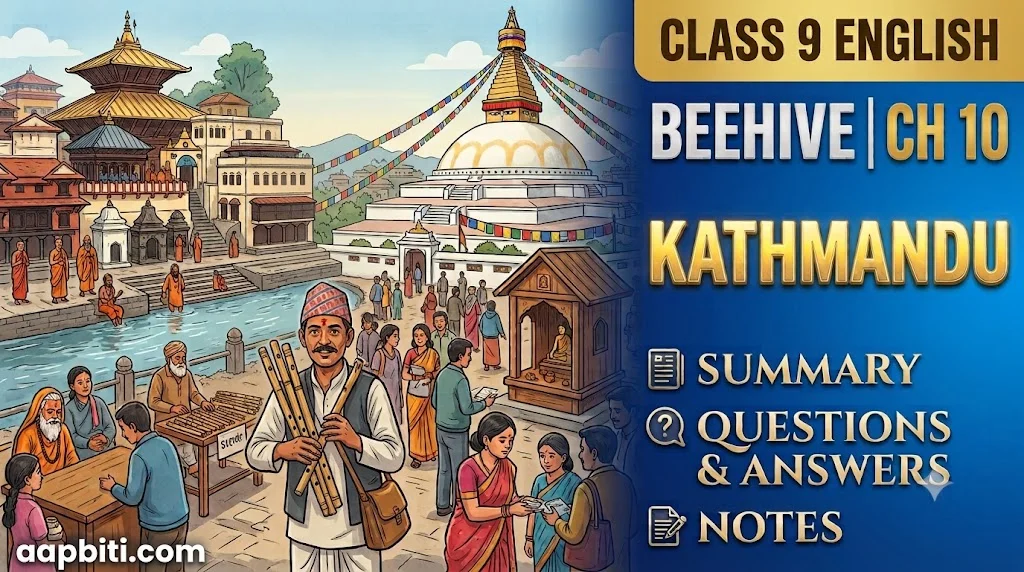
| Places | Pashupatinath temple, Boudhanath stupa and the streets of Kathmandu |
| Key contrast | "Febrile confusion" at Pashupatinath and "a haven of quietness" at Boudhanath |
| Central idea | Different places have different atmospheres, and music such as the flute can unite all human beings |
Summary of the Chapter
The author begins at the Pashupatinath temple, one of the most sacred Hindu shrines. The place is crowded and noisy, and he describes the atmosphere as one of "febrile confusion". Worshippers who want the priest's attention are elbowed aside by others pushing to the front. A group of saffron-clad Westerners tries to get past the gate, but only Hindus are allowed inside. Two monkeys start a fight, and one of them jumps on a shivalinga and then runs screaming around the temples and down to the river Bagmati. Beside the river, a corpse is being cremated, while washerwomen wash clothes and their children bathe. A small shrine on the stone platform is said to be rising slowly, and it is believed that when it emerges fully, the goddess inside will escape and the evil age of Kaliyuga will end.
From this noisy scene, the author goes to the Boudhanath stupa, a Buddhist shrine, and finds a haven of quietness amid the busy streets. The stupa has an immense white dome, ringed by a road with small shops on the outer edge selling felt bags, Tibetan prints and silver jewellery. There are no crowds, and the place has a sense of stillness and serenity.
The author then describes Kathmandu's narrow, busy streets, which have small shrines with flower-adorned deities, fruit sellers, hawkers of postcards, and shops selling Western cosmetics, film rolls, chocolate, copper utensils and Nepalese antiques. Film songs blare from radios, and car horns and bicycle bells add to the noise. In the middle of all this, a flute seller with fifty or sixty bansuris on a bamboo pole plays a flute slowly and meditatively. The author enjoys local snacks such as marzipan and roasted corn-on-the-cob, washed down with Coca-Cola. He ends by saying that flute music is the most universal and most particular of sounds, and that hearing any flute draws us into the commonality of all mankind.
Two Shrines Compared
| Point | Pashupatinath temple | Boudhanath stupa |
|---|---|---|
| Religion | Hindu | Buddhist |
| Atmosphere | Noisy, crowded and confused | Calm, still and serene |
| People | Worshippers pushing, Western visitors, priests | No crowds; shopkeepers at the edge |
| Scenes | Fighting monkeys, cremation, washerwomen at the Bagmati | Immense white dome, ring road, small shops |
NCERT Textbook Questions with Answers
Before You Read
Q1. Do you like travelling? Ans. Yes, I like travelling, because it gives an insight into the unknown world and teaches us about other cultures.
Q2. Have you heard of places like Ajmer Sharif, Madurai, Sanchi, Varanasi, Sarnath or Halebid? Can you name some other places like these? Ans. Yes, I have heard of them. Other such places are Amarnath, Vaishno Devi, Haridwar, Ujjain and Shirdi.
Q3. What do the surroundings of a holy place in your city look like? Ans. Usually they are cluttered, noisy and crowded. Shops selling flowers, idols and prasad line the streets, and hundreds of devotees visit daily.
Thinking about the Text I: One or Two Words or Short Phrases
Q1. Name the two temples the author visited in Kathmandu. Ans. The Pashupatinath temple and the Boudhanath stupa.
Q2. The writer says, "All this I wash down with Coca-Cola." What does "all this" refer to? Ans. It refers to a bar of marzipan, a corn-on-the-cob roasted in a charcoal stove and rubbed with salt, chilli powder and lemon, a couple of love-story comics and a Reader's Digest.
Q3. What does Vikram Seth compare to the quills of a porcupine? Ans. He compares the fifty or sixty bansuris sticking out in all directions from the flute seller's bamboo pole to the quills of a porcupine.
Q4. Name five kinds of flutes. Ans. The reed ney, the Japanese shakuhachi, the deep bansuri of Hindustani classical music, the clear or breathy flutes of South America and the high-pitched Chinese flutes.
Thinking about the Text II: A Short Paragraph
Q1. What difference does the author note between the flute seller and the other hawkers? Ans. The flute seller picked up a flute from time to time and played it for a few minutes. The sound rose clearly above the noise of the traffic and the other hawkers' cries. He played slowly and meditatively, without any show, while the other hawkers kept shouting out their wares.
Q2. What is the belief at Pashupatinath about the end of Kaliyug? Ans. At Pashupatinath, a small shrine is slowly protruding from the stone platform on the riverbank. It is believed that when it emerges fully, the goddess inside will escape, and the evil age of Kaliyuga will end on earth.
Q3. Pick out three examples each of (i) the atmosphere of "febrile confusion" outside the Pashupatinath temple, (ii) the things he sees, and (iii) the sounds he hears. Ans. (i) Worshippers trying to get the priest's attention are elbowed aside by others; saffron-clad Westerners struggle for permission to enter the temple, which only Hindus may enter; two monkeys fight, and one runs screaming around the temples and down to the Bagmati. (ii) The immense white dome of the Boudhanath stupa ringed by a road; small shops selling felt bags, Tibetan prints and silver jewellery; fruit sellers, flute sellers, postcard hawkers and shops with Western cosmetics, chocolate, copper utensils and Nepalese antiques. (iii) Film songs blaring from radios; car horns and bicycle bells; vendors shouting out their wares, and the flute music.
Thinking about the Text III: 100 to 150 Words Each
Q1. Compare and contrast the atmosphere in and around the Boudhanath shrine with the Pashupatinath temple. Ans. The Pashupatinath temple was full of noise, chaos and confusion. Worshippers were trying to attract the priest's attention, and others were pushing to the front. Saffron-clad Westerners were trying to enter, though only Hindus were allowed inside. Monkeys were fighting and adding to the noise. A corpse was being cremated on the bank of the Bagmati, and washerwomen were working while their children bathed nearby. In contrast, the Boudhanath stupa was a haven of quietness in the busy streets around it. There were no crowds, and the Buddhist shrine had a sense of stillness and serenity, with an immense white dome and a few quiet shops around it.
Q2. How does the author describe Kathmandu's busiest streets? Ans. Along the narrowest and busiest streets of Kathmandu, there were small shrines with flower-adorned deities. Apart from these, there were fruit sellers, flute sellers, hawkers of postcards and shops selling Western cosmetics, film rolls, chocolate, copper utensils and Nepalese antiques. The streets were also noisy, with film songs blaring from radios, car horns, bicycle bells and vendors shouting out their wares. In the middle of this noise stood a flute seller with many bansuris, whose slow music contrasted with the cries of the hawkers. The streets were full of life and colour.
Q3. "To hear any flute is to be drawn into the commonality of all mankind." Why does the author say this? Ans. The author considers flute music to be the most universal and most particular of all sounds. Every culture has its own flute, and each kind has its own fingering and range and weaves its own associations. Yet, every flute produces music with the help of human breath. In the same way, human beings differ in caste, culture, religion and region, but the same living breath runs through all of them. So when we hear any flute, we feel our common humanity.
Thinking about Language I: Phrasal Verbs with "Break"
Ans. (1) break out: begin suddenly. (2) break off: separate or become detached. (3) break down: stop working. (4) break away: escape from someone. (5) break up: separate or end a relationship. (6) break into: enter a place by force. Match these meanings with the Column B items in your book.
Thinking about Language II: Nouns with -ion or -tion
Q1. Form nouns. Ans. cremate: cremation; act: action; exhaust: exhaustion; invent: invention; tempt: temptation; immigrate: immigration; direct: direction; meditate: meditation; imagine: imagination; dislocate: dislocation; associate: association; dedicate: dedication.
Q2. Fill in the blanks. Ans. (i) invention, (ii) direction, (iii) temptation, (iv) dedication, (v) exhaustion.
Thinking about Language III: Punctuation
Ans. An arrogant lion was wandering through the jungle. One day, he asked the tiger, "Who is stronger than you?" "You, O lion!" replied the tiger. "Who is more fierce than a leopard?" asked the lion. "You, sir," replied the leopard. He marched up to an elephant and asked the same question. The elephant picked him up in his trunk, swung him in the air and threw him down. "Look," said the lion, "there is no need to get mad just because you don't know the answer."
Thinking about Language IV: Simple Present Tense
Ans. (1) The heart is a pump that sends the blood circulating through our body. The pumping action takes place when the left ventricle of the heart contracts. This forces the blood out into the arteries, which expand to receive the oncoming blood.
(2) The African lungfish can live without water for up to four years. During a drought it digs a pit and encloses itself in a capsule of slime and earth, leaving a tiny opening for air. The capsule dries and hardens, but when rain comes, the mud dissolves and the lungfish swims away.
(3) Mahesh: We have to organise a class party for our teacher. Does anyone play an instrument? Vipul: Rohit plays the flute. Mahesh: Does he also act? Vipul: No, he composes music. Mahesh: That's wonderful!
Speaking
Q. Give a running commentary on a sports event or a parade, using the simple present and present continuous tenses. Ans. A model on cricket: "The bowler runs in and bowls a fast one. The batsman plays it past the fielder at cover, and the batsmen are running for a second run. The fielder is throwing the ball to the keeper, but the batsman reaches the crease safely. The crowd is cheering loudly, and the scoreboard shows 82 for two." For a shrine, speak about one you have visited: its place, its crowd, its sounds and your feelings.
Writing
Q1. Record in point form what you see at the Pashupatinath temple. Ans. On reaching: a crowded gate, priests and worshippers, a river nearby. Inside: worshippers pushing, offerings and the shivalinga. Outside: fighting monkeys, a cremation on the Bagmati, washerwomen and bathing children. Impressions: noisy, crowded and chaotic, yet deeply religious.
Q2. Write a travelogue on your visit to Agra and the Taj Mahal from the diary notes. Ans. In January 2003, I rose before dawn and took the Shatabdi Express from Delhi at 6.15 a.m. On the train, I met a newly married couple, and we talked about Himachal Pradesh. We got off at Agra, once a grand city, and entered its twisted alleys, where the traffic was dense with rickshaws, cars and people. Vendors were selling religious artefacts, plastic toys, spices and sweets. Finally, we reached the Taj Mahal, built entirely of white marble. It had a magical quality, and its colour seemed to change with the light and shadow. I saw the gemstones set into the marble and the Taj reflected in the pond. School children and tourists crowded around, and guides followed everyone. The visit was unforgettable.
Extra Questions and Answers
Very Short Answer Type (1 Mark)
Q1. Who wrote "Kathmandu"? Ans. Vikram Seth. Q2. Which book is the chapter taken from? Ans. Heaven Lake. Q3. Which river flows beside Pashupatinath? Ans. The Bagmati. Q4. Who is allowed to enter the Pashupatinath temple? Ans. Only Hindus. Q5. What colour is the dome of the Boudhanath stupa? Ans. White. Q6. Which drink does the author have with his snacks? Ans. Coca-Cola.
Short Answer Type (30 to 40 Words)
Q1. Why does the author call the atmosphere at Pashupatinath "febrile confusion"? Ans. There was great excitement and disorder: pushing worshippers, struggling Westerners, fighting monkeys and noise. The scene felt feverish and chaotic.
Q2. What does the author mean by "a haven of quietness"? Ans. The Boudhanath stupa was a peaceful, calm place amid busy streets, where people could find relief from noise and crowds.
Q3. What do the monkeys do at Pashupatinath? Ans. Two monkeys fight, and one chases the other. The chased monkey jumps on a shivalinga and then runs screaming around the temples and down to the river.
Q4. How does the flute seller's music differ from the hawkers' cries? Ans. The flute music is slow, clear and meditative and rises above the noise, while the hawkers shout loudly to sell their goods.
Long Answer Type (100 to 120 Words)
Q1. "Kathmandu is a city of contrasts." Discuss with reference to the text. Ans. Kathmandu shows contrasts in its sights and sounds. The Pashupatinath temple is noisy and chaotic, with pushing crowds, fighting monkeys and a cremation beside washerwomen, while the Boudhanath stupa is calm and serene. The busy streets carry the din of film songs, car horns and shouting hawkers, yet the flute seller's slow music rises clearly above them. Ancient shrines stand next to shops selling Western cosmetics and chocolate. The city thus mixes the sacred and the commercial, the noisy and the peaceful, the old and the modern.
Q2. What do we learn about Vikram Seth as a traveller from this chapter? Ans. Vikram Seth is a keen observer who notices even small details, such as the fighting monkeys, the washerwomen and the porcupine-like bansuris. He enjoys local food and street life, and he mixes with ordinary people. He compares places thoughtfully, noticing the difference between the two shrines. He is also sensitive to music, finding in the flute a symbol of the unity of all human beings. His writing is vivid, humorous and full of sensory images.
Important Words and Meanings
| Word | Meaning |
|---|---|
| Febrile | Feverish and restless |
| Stupa | A dome-shaped Buddhist shrine |
| Haven | A place of safety and peace |
| Hawker | A person who sells goods in the street |
| Commonality | Sharing of common features |
| Cremate | To burn a dead body |
Themes and Quick Revision
Themes: The chapter highlights the variety of religious and cultural life, the contrast between chaos and calm, and the power of music to unite human beings.
| Memory Aid | Remember |
|---|---|
| Two shrines | Pashupatinath: chaos. Boudhanath: calm. |
| Porcupine | The flute seller's fifty or sixty bansuris. |
| Key line | Any flute draws us into the commonality of all mankind. |
Conclusion: "Kathmandu" teaches us to observe places carefully and to see the common humanity beneath cultural differences. For exams, remember the comparison of the two shrines, the Kaliyug belief, the three examples of images, the flute idea and the language exercises. The chapter also contains the poem "A Slumber Did My Spirit Seal", which is not covered here.

"Naina Saini is an Editorial Intern at Aapbiti, specializing in publishing and managing education-focused news articles. Operating under the direct mentorship and guidance of Shakti Rao Mani, the Product Owner of aapbiti.com, Naina is dedicated to delivering accurate, timely, and engaging academic updates. Her role focuses on keeping readers informed about educational trends, exams, admissions, and key academic policies."




Comments (0)