CBSE Class IX Scheme of Studies 2026-27: New Rules, Compulsory Vocational Education & Curriculum Changes
Complete guide on CBSE Circular Acad-70/2026 for Class IX (2026-27) and Class X (2027-28). Learn about compulsory vocational education, subject removals, assessment patterns, and pass criteria.
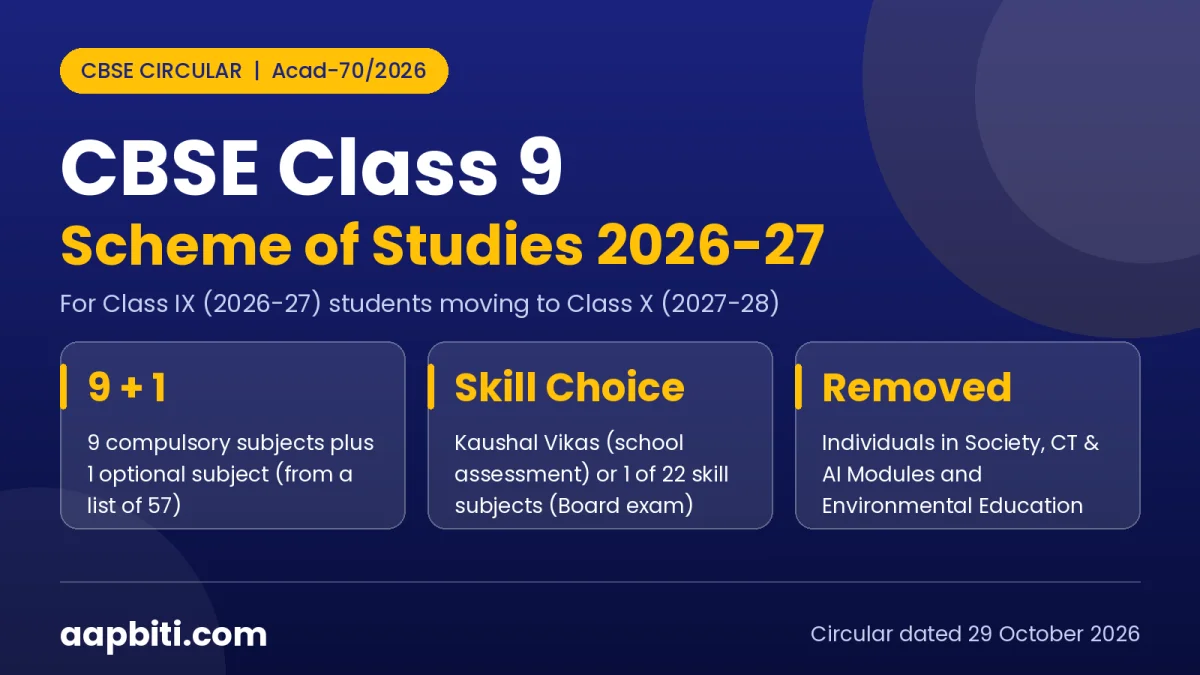
The Central Board of Secondary Education (CBSE) has issued Circular No. Acad-70/2026 dated 29 October 2026, announcing the Scheme of Studies for students of Class IX (session 2026-27) who will move to Class X in 2027-28. The circular, signed by Dr. Praggya M. Singh, Professor & Director (Academics), has been sent to the heads of all CBSE-affiliated schools. It removes some planned subjects, makes Vocational Education compulsory and explains in detail how each subject will be assessed.
In this article, we explain the circular in simple language so that students and parents can understand what is changing and what they need to decide. You can read the original circular on the CBSE Academic website.
CBSE Class IX Scheme of Studies 2026-27: Quick Overview
| Point | Details |
|---|---|
| Circular number and date | Acad-70/2026, 29 October 2026 |
| Applicable batch | Class IX 2026-27 and Class X 2027-28 |
| Current Class X (2026-27) | Not affected; the old scheme continues |
| Compulsory subjects | 9 subjects, including Vocational (Skill) Education |
| Optional subject | One optional subject from a list of 57 |
| Removed for this batch | Individuals in Society, CT & AI Modules, Environmental Education |
What Has Been Removed From the Curriculum?
The circular says that the Inter-disciplinary Area is being aligned with the implementation schedule. Because of this, three items will not be part of the curriculum for the current Class IX batch:
- The subject Individuals in Society in Class IX (2026-27)
- The Modules of CT & AI (Computational Thinking and Artificial Intelligence) in Class IX (2026-27)
- The subject Environmental Education in Class X (2027-28)
This means students will not have to prepare for these items in the coming two years. Other optional subjects that were available in the 2025-26 scheme will continue to be offered in both Class IX and Class X.
The 9 Subjects Every Student Must Study
According to the FAQ section attached to the circular, students of Class IX (2026-27) and Class X (2027-28) must study the following nine subjects:
- Language R1
- Language R2
- Mathematics
- Science
- Social Science
- Language R3
- Art Education
- Physical Education and Well-being (PE&WB)
- Vocational Education (Skill Education)
In addition, a student may take one optional subject. Students may also opt for Mathematics Advanced and Science Advanced as optional subjects. If a language is chosen as the optional subject, it must be different from the languages chosen as R1, R2 and R3.
Vocational Education Is Now Compulsory
The most important change is that Vocational Education stays a compulsory curricular area. A student must choose one of two paths.
Path 1: Kaushal Vikas
Kaushal Vikas is assessed only internally by the school. There is no Board exam for it. The school awards marks along with grades, and issues its own certificate to students who score at least 33% marks in the internal assessment.
Path 2: One of the 22 Skill Subjects
A student who selects any one of the 22 skill subjects must appear in the Board Examination for that subject in Class X (2027-28). The marks and grades appear on the Board marksheet, and an NSQF certificate is awarded to students who pass the exam.
List of 22 Skill Subjects (Annexure-I)
| Code | Subject | Code | Subject |
|---|---|---|---|
| 401 | Retail | 412 | Marketing & Sales |
| 402 | Information Technology | 413 | Health Care |
| 403 | Security | 414 | Apparel |
| 404 | Automotive | 415 | Multi Media |
| 405 | Introduction to Financial Markets | 416 | Multi Skill Foundation Course |
| 406 | Introduction to Tourism | 417 | Artificial Intelligence |
| 407 | Beauty & Wellness | 418 | Physical Activity Trainer |
| 408 | Agriculture | 419 | Data Science |
| 409 | Food Production | 420 | Electronics and Hardware |
| 410 | Front Office Operations | 421 | Foundation Skills for Sciences (Pharmaceutical and Biotechnology) |
| 411 | Banking & Insurance | 422 | Design Thinking and Innovation |
How Will Subjects Be Assessed in Class X (2027-28)?
In Class IX (2026-27), assessment is school-based, as per the rubrics already given in the syllabus. In Class X (2027-28), the pattern becomes as follows:
| Subject | Assessment |
|---|---|
| Language R1, Language R2, Mathematics, Science, Social Science | School-based Internal Assessment and Board Examination |
| Mathematics Advanced (optional), Science Advanced (optional) | Board Examination |
| Language R3, Art Education, Physical Education and Well-being | School-based Internal Assessment |
| Vocational Education | Kaushal Vikas: school-based internal assessment. Any one of the 22 skill subjects: Board Examination |
| Optional Subject | School-based Internal Assessment and Board Examination |
In short, five subjects always have a Board exam. Optional subjects, Mathematics Advanced, Science Advanced and a chosen skill subject will have a Board exam only if the student opts for them.
Grades for Internal Subjects
For Art Education and PE&WB, schools will award only grades, not marks. Schools will issue their own certificates to students who get grade D or above. The same grading scale is used for Kaushal Vikas, where marks are also shown.
| Marks Range | Grade |
|---|---|
| 91-100 | A1 |
| 81-90 | A2 |
| 71-80 | B1 |
| 61-70 | B2 |
| 51-60 | C1 |
| 41-50 | C2 |
| 33-40 | D |
| Less than 33 | E |
Pass Criteria for Class X Board Exam
To be declared pass, a student must score at least 33% in each of the five Board subjects: Language R1, Language R2, Mathematics, Science and Social Science. A student is considered pass in a subject if the combined total of Internal Assessment and Board exam is 33% or more.
The circular gives an example: a student who gets 24 out of 80 in the Board exam and 9 out of 20 in Internal Assessment has 33 out of 100 in total, and will be declared pass.
Replacement of Subjects: A Second Chance
The scheme also has a replacement provision, which can protect a student's result in Class X.
If the Student Has Taken a Skill Subject
If a student scores less than 33% in any one of Science, Mathematics or Social Science, but passes the skill subject, the skill subject will replace the failed subject and the result will be computed accordingly. This replacement is not available for students who chose Kaushal Vikas.
If the Student Has Taken an Optional Language
If a student scores less than 33% in Language R1 or R2, but passes in the optional language (different from R1, R2 and R3), the optional language will replace it, and the result will be computed accordingly.
This makes the choice between Kaushal Vikas and a skill subject more important than it may look at first. A skill subject adds a Board exam, but it also gives a safety net.
List of 57 Optional Subjects
The optional subjects listed in the FAQ cover a wide range:
- Indian languages (35): including Assamese, Bengali, Bhoti, Bhutia, Bodo, Dogri, Gujarati, Gurung, Hindi, Kannada, Kashmiri, Kok Borok, Konkani, Lepcha, Limboo, Maithili, Malayalam, Manipuri, Marathi, Mizo, Nepali, Odia, Punjabi, Rai, Sanskrit, Santhali, Sherpa, Sindhi, Tamang, Tamil, Tangkhul, Telugu (AP), Telugu (Telangana), Tibetan and Urdu
- Foreign and other languages (10): English, Arabic, Bahasa Melayu, French, German, Japanese, Persian, Russian, Spanish and Thai
- Music (6): Carnatic Music (Vocal, Melodic Instruments, Percussion Instruments) and Hindustani Music (Vocal, Melodic Instruments, Percussion Instruments)
- Other subjects (6): Painting, Home Science, National Cadet Corps (NCC), Computer Applications, Elements of Business, and Elements of Book Keeping & Accountancy
Provisions for Children with Special Needs (CwSN)
The circular has a separate provision for Children with Special Needs. They must study one compulsory language with a Board exam. For the remaining four Board subjects, they can choose from:
- Mathematics, Science and Social Science
- Any other language from the optional list (different from the one already chosen)
- Music (any one of the six types), Painting or Home Science
- Elements of Business, Elements of Bookkeeping and Accountancy, or Computer Application
- A maximum of two skill subjects from the 22, except Automotive
Note that Information Technology, Computer Application and Artificial Intelligence cannot be taken together.
What Should Students and Parents Do Now?
- Talk to the school early. The choice between Kaushal Vikas and a skill subject should be made carefully, as a skill subject means an extra Board exam in Class X.
- Check the optional language rule. The optional language must differ from R1, R2 and R3.
- Do not worry if you are in Class X now. Students in Class X (2026-27) will follow the old scheme.
- Verify from official sources. Read the circular and its annexures on the CBSE Academic website and watch the main CBSE website for further notices.
Conclusion
CBSE Circular Acad-70/2026 gives clarity to students who are now in Class IX. It removes Individuals in Society, CT & AI Modules and Environmental Education for this batch, keeps nine core subjects with one optional subject, and makes Vocational Education compulsory through either internal assessment (Kaushal Vikas) or a Board exam (22 skill subjects). The pass rules and replacement provisions are clearly stated, so students can plan their subject choices well in advance. For any school-level questions, students and parents should contact their school principal and refer to the official CBSE circular.
Frequently Asked Questions

"Naina Saini is an Editorial Intern at Aapbiti, specializing in publishing and managing education-focused news articles. Operating under the direct mentorship and guidance of Shakti Rao Mani, the Product Owner of aapbiti.com, Naina is dedicated to delivering accurate, timely, and engaging academic updates. Her role focuses on keeping readers informed about educational trends, exams, admissions, and key academic policies."




Comments (0)