

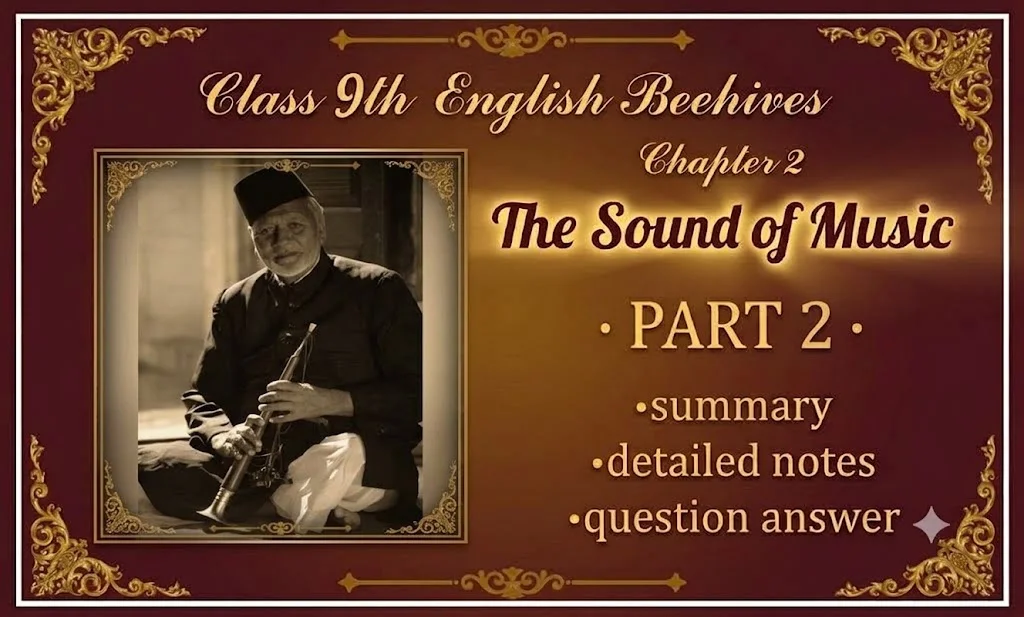
The Sound of Music Part 2 The Shehnai of Bismillah Khan Class 9 Summary, Question Answers and Notes
Read the complete summary, NCERT solutions, extra questions, and important notes for CBSE Class 9 English Beehive Chapter 2 Part 2 "The Shehnai of Bismillah Khan".


Chapter at a Glance
| Point | Detail |
|---|---|
| Subject | Ustad Bismillah Khan, shehnai maestro |
| Birthplace | Dumraon, Bihar (later lived in Benaras) |
| Teacher | His maternal uncle Ali Bux |
| Big break | All India Radio, Lucknow, 1938 |
| Highest honour | Bharat Ratna |
| Central idea | Love for music, simplicity and attachment to one's roots |
Summary of Part 2
The text begins with the history of the shehnai. It grew out of the pungi, a reeded noisemaker that was played in the royal residence of Indian rulers. Emperor Aurangzeb banned it because its sound was shrill and unpleasant. A barber from a family of professional musicians, who had access to the royal court, improved it. He took a pipe with a natural hollow stem that was longer and broader than the pungi, and he made holes in its body. The new instrument produced a soft and melodious sound and was played in the royal court. Because the barber was a "nai" and the instrument was played before the "shah", it came to be called the shehnai.


The shehnai became part of the naubat, a group of nine instruments at royal courts, and its sound began to be considered auspicious. It was played at temples and weddings. Bismillah Khan was born in 1916 into a family of professional musicians who served in the courts of Bhojpur. As a boy he took to music very early. He went to Benaras, where his uncle Ali Bux, who played at the Vishwanath temple, taught him the shehnai. He practised for long hours on the banks of the Ganga and slowly became a master.
His big break came when All India Radio opened in Lucknow in 1938, and his playing was heard often. On 15 August 1947 he played the shehnai at the Red Fort and became the first Indian to greet the nation with it, with Pandit Nehru among the listeners. He travelled abroad, first to Afghanistan, and was loved everywhere. Yet he never left Benaras. When admirers in the U.S.A. offered to set up a shehnai school for him, he refused, saying that he missed Hindustan and the Ganga. He disliked the film world, but he loved teaching children music. He received the Bharat Ratna and many other honours. He lived simply and worked until the end.
Pungi vs Shehnai
| Feature | Pungi | Shehnai |
|---|---|---|
| Sound | Shrill and unpleasant | Soft and melodious |
| Build | A reeded pipe | Longer, broader pipe with holes in its body |
| Status | Banned by Aurangzeb | Played in royal courts, temples and weddings |
NCERT Textbook Questions with Answers
Thinking about the Text (Part II): Tick the Right Answer
1. The pungi was a "reeded noisemaker". 2. A barber transformed the pungi into a shehnai. 3. Bismillah Khan's paternal ancestors were professional musicians. 4. He learnt to play the shehnai from Ali Bux. 5. His first trip abroad was to Afghanistan.


Bismillah Khan's Feelings (Positive, Negative or Neutral)
Teaching children music: Positive. The film world: Negative. Migrating to the U.S.A.: Negative. Playing at temples: Neutral. Getting the Bharat Ratna: Positive. The banks of the Ganga: Positive. Leaving Benaras and Dumraon: Negative. Match each item with the words of the text that show his feeling, and discuss them in class.
Answer These Questions in 30 to 40 Words
Q1. Why did Aurangzeb ban the playing of the pungi? Ans. Aurangzeb banned the pungi because its sound was shrill and unpleasant, and he did not want such a noisy instrument played in the royal residence.
Q2. How is a shehnai different from a pungi? Ans. A shehnai is a pipe with a natural hollow that is longer and broader than a pungi and has holes in its body. It produces a sweet, soft sound.
Q3. Where was the shehnai played traditionally? How did Bismillah Khan change this? Ans. The shehnai was traditionally played in the naubat at royal courts, and later in temples and North Indian weddings. Bismillah Khan brought it to the classical stage and made it a concert instrument.
Q4. When and how did Bismillah Khan get his big break? Ans. His big break came in 1938, when All India Radio opened in Lucknow. His shehnai was heard often on the radio, and this made him famous across the country.
Q5. Where did Bismillah Khan play the shehnai on 15 August 1947? Why was the event historic? Ans. He played at the Red Fort. The event was historic because India became independent that day, and he was the first Indian to greet the free nation with his shehnai. Pandit Nehru was present.
Q6. Why did Bismillah Khan refuse to start a shehnai school in the U.S.A.? Ans. He loved India so much that he did not want to leave it. He felt an unbreakable bond with Benaras, Dumraon and the Ganga, and he yearned for Hindustan whenever he was abroad.
Q7. Find at least two instances in the text which tell you that Bismillah Khan loves India and Benaras. Ans. First, he says that whenever he is in a foreign country, he keeps yearning to see Hindustan. Second, he says that when he is in Mumbai, he thinks only of Benaras and the holy Ganga.
Thinking about Language
I. Complete with a to-verb. (1) The school sports team hopes to win. (2) We all want to live a healthy life. (3) They advised the child's mother to consult a specialist. (4) The authorities permitted us to use the stadium. (5) A musician decided to play the guitar. Other sensible answers are also accepted.
II. Find the word or phrase from the text. (1) The home of royal people: royal residence. (2) The state of being alone: solitude. (3) A part that is absolutely necessary: indispensable. (4) To do something not done before: invent. (5) Without much effort: effortlessly. (6) Quickly and in large quantities: thick and fast.
III. Tick the right answer. (1) When something is revived, it lives again. (2) When a government bans something, it wants it stopped. (3) When something is auspicious, we welcome it. (4) When we take to something, we find it interesting. (5) When you appreciate something, you find it good and useful. (6) When you replicate something, you do it for the second time. (7) When we come to terms with something, it is no longer upsetting.
IV. Dictionary work (adjectives). Indispensable: both before a noun and after the verb be. Impressed: both. Afraid: only after the verb be, not before a noun. Outdoor: only before a noun. Paternal: only before a noun. Countless: only before a noun. Priceless: both. Example: "Electronic gadgets have become indispensable to modern life."
Speaking: Introducing Kishori Amonkar
Notes: parentage: daughter of Smt. Mogubai Kurdikar; school: Jaipur-Atrauli gharana, with her own individual style; inspiration: the ancient Vedic sages; awards: Sangeet Natak Akademi (1985), Padma Bhushan (1987), Sangeet Samradhini (1997). Introduction: "Good morning everyone. I am honoured to introduce Padma Bhushan Kishori Amonkar, widely considered the finest female vocalist of her generation. Born in 1931, she is the daughter of the great artist Smt. Mogubai Kurdikar. She belongs to the Jaipur-Atrauli gharana, yet she has developed her own style. Inspired by the Vedic sages, she explores every raga with a thinker's care. She has received the Sangeet Natak Akademi Award, the Padma Bhushan and the Sangeet Samradhini Award. Please welcome her."
Writing: "If you work hard and know where you're going, you'll get there"
Ans. Yes, both musicians worked very hard. Evelyn Glennie lost her hearing by the age of eleven, but she wanted to be a professional musician. With the help of Ron Forbes, she learned to feel sound through her body, entered the Royal Academy of Music and became a world-famous percussionist. Ustad Bismillah Khan came from a family of musicians and practised for long hours on the banks of the Ganga. He wanted to bring the shehnai out of temples and weddings onto the classical stage. He achieved this and earned the Bharat Ratna.
Extra Questions and Answers
Very Short Answer Type (1 Mark)
Q1. Who taught Bismillah Khan the shehnai? Ans. His uncle, Ali Bux. Q2. What was the pungi? Ans. A reeded noisemaker. Q3. Which award did Khan receive as India's highest civilian honour? Ans. The Bharat Ratna. Q4. What is a naubat? Ans. A traditional ensemble of nine instruments played at royal courts. Q5. Which raga did he play at the Red Fort? Ans. Raga Kafi.
Short Answer Type (30 to 40 Words)
Q1. Why was the instrument called the shehnai? Ans. The barber, called a "nai", played it before the king, or "shah". The instrument that the nai played in the shah's court came to be known as the shehnai.
Q2. How did Bismillah Khan feel about the film world? Ans. He did not like the artificial, glamorous film world. He worked briefly with films but felt uncomfortable and preferred the simple life and music of Benaras.
Q3. What does the text say about his attitude towards teaching? Ans. Khan loved teaching children music and wished to pass on the art. He believed that music should be spread, and he enjoyed the company of young learners.
Q4. Why is the shehnai considered auspicious? Ans. Its sweet sound was played at royal courts, temples and weddings, so people began to associate it with good fortune and happy occasions.
Long Answer Type (100 to 120 Words)
Q1. Describe Bismillah Khan's attachment to Benaras and India. Ans. Bismillah Khan was born in Dumraon but spent most of his life in Benaras, where he learned the shehnai from his uncle and practised on the banks of the Ganga. Even after he became world famous, he refused to leave the city. When admirers in the U.S.A. offered him a shehnai school, he refused because he could not imagine life away from Benaras and the Ganga. He said that whenever he was abroad he yearned for Hindustan, and in Mumbai he thought only of Benaras. His simplicity and love for his roots made him a great human being as well as a great artist.
Q2. How did Bismillah Khan make the shehnai famous? Ans. The shehnai had been limited to royal courts, temples and weddings. Bismillah Khan's dedicated practice and rich sound brought it to the classical stage. His big break came on All India Radio in 1938, and the whole country heard him. On 15 August 1947 he welcomed free India from the Red Fort. He performed in many countries and received honours such as the Bharat Ratna. Through his talent, hard work and love for music, he turned a humble folk instrument into a respected concert instrument.
Quick Revision
| Memory Aid | Remember |
|---|---|
| Pungi to Shehnai | Banned by Aurangzeb, improved by a barber (nai) for the shah. |
| 1938 and 1947 | Radio break at Lucknow, and the Red Fort on Independence Day. |
| Ganga and Benaras | Reason he refused to settle in the U.S.A. |
Conclusion: Both parts of the chapter show that music is a language of dedication. Evelyn Glennie and Bismillah Khan reached the top through hard work, love for their art and belief in themselves. For exams, remember the shehnai's history, the key dates, Khan's attachment to Benaras and the language exercises.

"Naina Saini is an Editorial Intern at Aapbiti, specializing in publishing and managing education-focused news articles. Operating under the direct mentorship and guidance of Shakti Rao Mani, the Product Owner of aapbiti.com, Naina is dedicated to delivering accurate, timely, and engaging academic updates. Her role focuses on keeping readers informed about educational trends, exams, admissions, and key academic policies."












Comments (0)