

The Snake and the Mirror Class 9 English Beehive Chapter 5 Summary, Question Answers and Notes
Complete notes, summary, NCERT question answers, extra questions, and grammar exercises for Class 9 English Beehive Chapter 5 "The Snake and the Mirror". Easy explanation and quick revision guide.


Chapter at a Glance
| Point | Detail |
|---|---|
| Author | Vaikom Muhammad Basheer (translated from Malayalam) |
| Narrator | A homeopathic doctor, a bachelor living in a small rented room |
| Tone | Humorous, with self-mockery |
| Key objects | A snake, a mirror, a lamp |
| Central idea | Vanity and daydreams look silly when real danger arrives, and humour can make a frightening moment memorable |
Summary of the Story
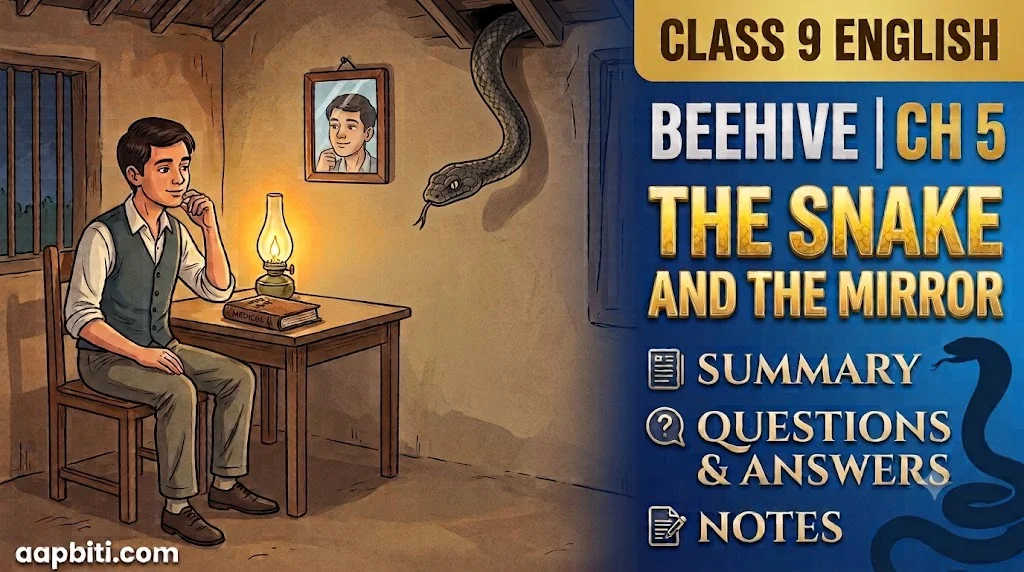
The narrator is a young homeopathic doctor who lives alone in a small rented room. He has little money, a few clothes and a black coat, but he dreams of a better life. One night, as he sits in the lamplight, he hears a familiar sound from above. He thinks that rats are running about on the ceiling. The sound comes again and again, and then there is a dull thud, as if a rubber tube had fallen. After that, the sounds stop.


Suddenly a snake appears, and it coils round the doctor's arm. He is terrified. He does not tremble or cry out, but sits still, holding his breath, like a stone image. His arm slowly loses strength, and he silently prays to God. In the midst of this fear, he happens to look into a mirror on the table. He smiles at himself and thinks that he has an attractive smile. He makes two "earth-shaking" decisions: to shave every day and grow a thin moustache, and always to wear that charming smile. He even thinks about his future wife.
Then he remembers his danger and smiles feebly at himself, realising how close death may be. The snake loosens its hold, goes towards the mirror and seems to look at itself, as if it too were thinking of growing a moustache or wearing eye shadow. After a while it slithers away. The doctor suddenly feels like a man of flesh and blood again. He is relieved, and when he later tells the story, he laughs at his own vanity.
Where the Humour Comes From
| Contrast | Dream | Reality |
|---|---|---|
| His position | A handsome, ambitious man | A poor doctor in a small rented room |
| His wife | A fat woman doctor with plenty of money | A thin, reedy woman |
| His thoughts | Admiring his smile in the mirror | A snake coiled round his arm |
NCERT Textbook Questions with Answers
Thinking about the Text I
Q1. "The sound was a familiar one." What sound did the doctor hear? What did he think it was? How many times did he hear it? When and why did the sounds stop? Ans. The doctor heard a sound from above, and he thought it was the sound of rats on the ceiling. He heard it several times, marked by phrases such as "Again I heard that sound from above" and "Again came that noise from above". Finally there was a dull thud, as if a rubber tube had fallen. The sounds stopped when the snake appeared, because the snake itself had been the cause.


Q2. What two "important" and "earth-shaking" decisions did the doctor take while he was looking into the mirror? Ans. First, he decided to shave every day and grow a thin moustache so that he would look more handsome. Second, he decided to keep an attractive smile on his face at all times.
Q3. "I looked into the mirror and smiled," says the doctor. A little later he says, "I forgot my danger and smiled feebly at myself." What is the doctor's opinion about himself when (i) he first smiles and (ii) he smiles again? In what way do his thoughts change in between, and why? Ans. (i) When he first smiles, he is pleased and thinks that his smile is very attractive. (ii) When he smiles again, he laughs weakly at his own foolishness, because he realises that he may die. His thoughts change in between because of the snake. The danger on his arm makes him forget his vanity and see his real condition.
Thinking about the Text II: What Makes the Story Humorous?
Q1. The kind of person the doctor is (money, possessions) and the kind of person he wants to be (appearance, ambition). Ans. In reality, the doctor is poor. He has a small rented room, very little money, a few shirts and dhotis and a black coat. He wants to be a handsome, smart and ambitious man, so he plans to shave daily and grow a moustache.
Q2. The person he wants to marry and the person he actually marries. Ans. He wants to marry a fat woman doctor with a lot of money. In the end he marries a thin, reedy woman who could run like a sprinter. The gap between the two is the source of humour.
Q3. His thoughts when he looks into the mirror, and his thoughts when the snake is coiled round his arm. Ans. When he looks into the mirror, he feels content and proud of his smile, and he makes plans to improve his looks. When the snake is coiled round his arm, he sits still, holding his breath, terrified. He thinks that he is a poor, helpless doctor who may die. The contrast between the two moods makes the story funny.
Thinking about Language 1: Which Sentence Shows What?
Ans. (a) Was afraid of the snake: sentences 1 ("I was turned to stone"), 3 ("The arm was beginning to be drained of strength"), 4 (writing "O God" in imagination) and 5 ("I didn't tremble. I didn't cry out"). (b) Was proud of his appearance: sentences 6 ("I looked into the mirror and smiled. It was an attractive smile") and 8 ("I was after all a bachelor and a doctor too on top of it!"). (c) Had a sense of humour: sentences 9 (the rascal could have used the vest after washing it) and 10 (was it trying to grow a moustache or use eye shadow?). (d) Was no longer afraid of the snake: sentences 2 ("I was no mere image cut in granite") and 7 ("I was suddenly a man of flesh and blood").
Thinking about Language 2: Expressions of Fear
Ans. (1) I was turned to stone. (2) I sat there holding my breath. (3) In the light of the lamp, I sat there like a stone image in the flesh.
Thinking about Language 3: Match the Meanings
Ans. (1) "scared out of my wits": very frightened. (2) "got a fright": frightened by something that happens suddenly. (3) "nearly jumped out of his skin": frightened by something that happens suddenly. (4) "gave me a fright": makes another feel frightened. (5) "make your hair stand on end": makes another feel frightened. (6) "Paralyzed with fear": too scared to move. (7) "not moving a muscle": too scared to move.
Thinking about Language 4: Reported Questions
Ans. (1) Meena asked her friend if she thought her teacher would come that day. (2) David asked his colleague where he would go that summer. (3) He asked the little boy why he was studying English. (4) She asked me when we were going to leave. (5) Pran asked me if I had finished reading the newspaper. (6) Seema asked her how long she had lived there. (7) Sheila asked the children if they were ready to do the work.
Speaking
Ans. Narrate a real scary incident in your own words, using expressions like "scared out of my wits", "my hair stood on end" and "not moving a muscle". Begin with the place and time, describe the sounds or shapes you noticed, explain how you felt and end with what happened. A short model: "One night during a power cut, I heard a scratching sound at my window. I was paralysed with fear and sat there not moving a muscle. When my brother laughed and showed me a branch moving in the wind, I realised I had been scared out of my wits for nothing."
Dictation
Ans. Your teacher will dictate a paragraph about the Indian cobra. Read it twice beforehand and remember to use commas after introductory phrases, a semicolon between the two related ideas about hoods, and full stops at the end of each sentence.
Writing
Q1. Rewrite the story without its humour, merely as a frightening incident. What would you leave out? Ans. I would leave out the doctor's dreams of marriage, his plans for a moustache, his admiration of his smile and the funny comparison of the snake with a vain man. The story would then read: One night, a doctor alone in his room hears strange sounds above him. Suddenly a snake drops down and coils round his arm. He freezes, holds his breath and prays silently as his arm grows weak. After a long, terrifying time the snake loosens its grip and slides away. The doctor is left shaken but alive.
Q2. A monkey preens itself using a piece of mirror. Write a paragraph about what it is thinking. Ans. The monkey found a piece of mirror lying in the garden and looked into it with great curiosity. Seeing his face, he thought, "What a handsome fellow I am!" He tidied the hair on his head, smiled and admired his shiny eyes. He wondered whether the other monkeys would also be impressed. Then he turned the mirror to look at his tail and felt even prouder. He kept admiring himself, completely forgetting the fruits waiting on the tree.
Translation
Q. Compare the two translations (A and B) of the Murakami passage on tense, short incomplete sentences and sentence length. Which do you like and why? Ans. Translation A is in the past tense, uses longer, complete sentences and sounds like a story told after the event. Translation B is in the present tense and uses short, incomplete sentences such as "Perfect spaghetti-cooking music!", which makes it feel immediate and lively. I like B, because the present tense and short sentences make me feel that I am in the kitchen with the narrator. However, A is smoother and more formal, and some readers may prefer it.
Extra Questions and Answers
Very Short Answer Type (1 Mark)
Q1. Who wrote "The Snake and the Mirror"? Ans. Vaikom Muhammad Basheer. Q2. What was the narrator's profession? Ans. He was a homeopathic doctor. Q3. What did the doctor think the sound was? Ans. The sound of rats. Q4. What did the doctor decide to grow? Ans. A thin moustache. Q5. What was around the doctor's arm? Ans. A snake. Q6. Whom did he want to marry? Ans. A fat woman doctor with plenty of money.
Short Answer Type (30 to 40 Words)
Q1. How did the doctor react when the snake coiled round his arm? Ans. He froze like a stone image. He did not tremble or cry out but held his breath and silently prayed to God as his arm grew weak.
Q2. Why did the doctor smile at himself in the mirror? Ans. He was vain and thought he looked attractive. Even in danger, he admired his smile and made plans to improve his appearance.
Q3. What did the snake do near the mirror? Ans. The snake went towards the mirror and seemed to look at itself, as if it were also thinking of improving its looks. Then it slithered away.
Q4. How did the doctor feel after the snake left? Ans. He was relieved and felt like a man of flesh and blood again. He was no longer frozen with fear.
Long Answer Type (100 to 120 Words)
Q1. Write a character sketch of the doctor. Ans. The doctor is a young, poor homeopath who lives alone in a small room. He is vain, as shown by his love for his smile and his plans to grow a moustache. He is also imaginative and full of silly dreams, such as marrying a rich woman doctor. In danger, he behaves bravely in a quiet way, sitting still and not crying out. Above all, he has a sense of humour, because he narrates his own foolishness and laughs at himself. This honest self-mockery makes him a likeable character.
Q2. How does the author create humour in a frightening situation? Ans. The author contrasts the doctor's deadly danger with his trivial thoughts. While a snake is wrapped round his arm, the doctor admires his smile, decides to grow a moustache and imagines his marriage. He uses funny exaggeration, calling his decisions "earth-shaking", and he compares the snake with a vain person who may want eye shadow. The doctor also laughs at himself in the narration. Because the reader knows the danger, the doctor's vanity seems more comical, and the fear ends in laughter.
Important Words and Meanings
| Word | Meaning |
|---|---|
| Homeopath | A doctor who treats illness with homeopathic medicine |
| Feebly | Weakly |
| Coiled | Wound in loops round something |
| Vain | Too proud of one's looks |
| Preen | To spend time making oneself look attractive |
| Bachelor | An unmarried man |
Themes and Quick Revision
Themes: The story shows human vanity, the gap between dreams and reality, and the way humour helps us face fear. It also teaches that real danger puts our small worries into perspective.
| Memory Aid | Remember |
|---|---|
| Two decisions | Shave daily and grow a thin moustache; always keep an attractive smile. |
| Two smiles | First proud, then feeble and fearful. |
| Fear phrases | Turned to stone, holding my breath, stone image in the flesh. |
Conclusion: Basheer turns a frightening night into a comic tale and gently laughs at human vanity. For exams, remember the sounds, the two decisions, the contrasts that create humour, the fear expressions and the reported-speech exercise.

"Naina Saini is an Editorial Intern at Aapbiti, specializing in publishing and managing education-focused news articles. Operating under the direct mentorship and guidance of Shakti Rao Mani, the Product Owner of aapbiti.com, Naina is dedicated to delivering accurate, timely, and engaging academic updates. Her role focuses on keeping readers informed about educational trends, exams, admissions, and key academic policies."








Comments (0)