

Packing Class 9 English Beehive Chapter 7 Summary, Question Answers and Notes
Complete notes, summary, NCERT question answers, extra questions, and grammar exercises for Class 9 English Beehive Chapter 7 "Packing" by Jerome K. Jerome. Simple explanations and quick revision guide.


Chapter 8 part 1⇒ Chapter 8 part 2⇒


Chapter at a Glance
| Point | Detail |
|---|---|
| Author | Jerome K. Jerome (from Three Men in a Boat) |
| Narrator | Jerome himself |
| Characters | Jerome, George, Harris and the dog Montmorency |
| Genre | Humorous narrative |
| Central idea | Overconfidence and carelessness lead to funny disasters |
Summary
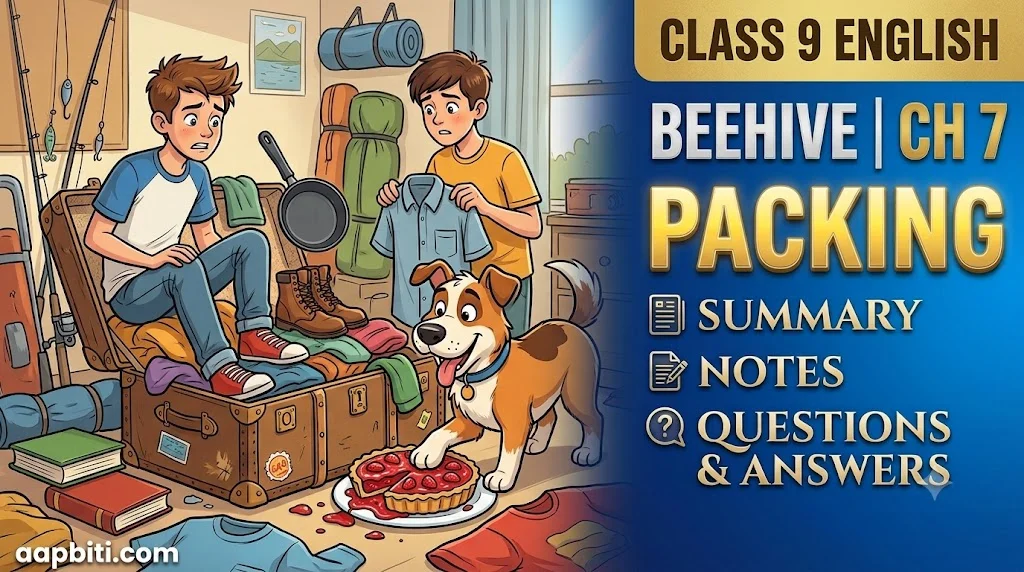
The narrator, Jerome, tells George and Harris that he will do all the packing for their trip, because he feels that nobody knows more about packing than he does. George and Harris readily agree. George settles into an easy-chair with a pipe, and Harris puts his legs on the table and lights a cigar. Jerome is irritated, because he had wanted to boss the job and have his friends work under his orders. He packs the bags himself and thinks that he has finished.
Then trouble begins. After the bag is shut and strapped, Harris asks whether the boots have been put in, and Jerome has to open it again. Later, Jerome has a horrible idea that he has forgotten his toothbrush. He turns everything out of the bag and, after a long search, finds the toothbrush inside a boot. He then repacks everything, but he realises that he has packed his tobacco-pouch, so he unpacks again. His friends enjoy watching him struggle.


Next, George and Harris offer to pack the hampers (food baskets). They break a cup, squash a tomato, step on the butter, put things behind them and cannot find them, and upset almost everything. The dog Montmorency makes matters worse. He sits on things that are about to be packed, puts his leg in the jam and pretends that the lemons are rats. Jerome simply watches the chaos. The story ends with the friends hunting for the butter, which is found stuck to Harris's back, and with Jerome's comment on how little anyone can do with so much butter.
NCERT Textbook Questions with Answers
Before You Read
Q. Do you like going on trips? How do you feel about packing? Have you ever forgotten something important? Ans. These are personal questions. A sample reply: "I enjoy trips to hill stations. Packing is tiring but exciting. Once I forgot my charger on a trip, and I laughed about it later."
Thinking about the Text I: A Short Paragraph (30 to 40 Words)
Q1. How many characters are there in the narrative? Name them. Ans. There are four characters: Jerome (the narrator), George, Harris and the dog Montmorency.
Q2. Why did the narrator volunteer to do the packing? Ans. Jerome took pride in his packing skills. He felt that he knew more about packing than any other person living.
Q3. How did George and Harris react to this? Did Jerome like their reaction? Ans. They readily accepted his suggestion. George took his pipe and spread himself over the easy-chair, and Harris put his legs on the table and lit a cigar. Jerome did not like it.
Q4. What was Jerome's real intention when he offered to pack? Ans. He wanted to boss the job while George and Harris worked under his directions. He would push them aside now and then and teach them how to do it properly.
Q5. What did Harris say after the bag was shut and strapped? Why do you think he waited till then? Ans. Harris asked whether Jerome was going to put the boots in. Jerome felt that Harris waited till the bag was strapped to annoy him and to make him do extra work.
Q6. What "horrible idea" occurred to Jerome a little later? Ans. He suddenly thought that he had forgotten to pack his toothbrush. He says that he always has this fear when he packs.
Q7. Where did Jerome finally find the toothbrush? Ans. He found it inside a boot.
Q8. Why did Jerome have to reopen the packed bag? Ans. He had to reopen it more than once. First he had forgotten to pack the boots. Then he had to search for the toothbrush, and later he found that he had packed his tobacco-pouch by mistake.
Q9. What did George and Harris offer to pack and why? Ans. They offered to pack the hampers (the food and drink baskets). Harris said that they would soon have to start, so it was better that he and George did the rest while Jerome took rest.
Q10. Tick the true statements about George and Harris packing the hamper. Ans. (i) They started with breaking a cup. (iii) They squashed a tomato. (iv) They trod on the butter. (vi) They put things behind them and could not find them. (vii) They stepped on things. Statements (ii), (v), (viii) and (x) are false. Statement (ix) "They upset almost everything" is not in the standard answer key, though it also fits the story, so check it against your book.
Thinking about the Text II
Q. What does Jerome say was Montmorency's ambition in life? What do you think of Montmorency and why? Ans. Jerome says that Montmorency's ambition was to get in the way and be scolded. The dog felt that its day was wasted if it could not go where it was not wanted and be a perfect nuisance. Its highest aim was to make somebody stumble over it and curse it for an hour. I think Montmorency is naughty, playful and attention-seeking, but also very funny, because it behaves just like a mischievous child.
Thinking about the Text III: Two or Three Paragraphs (100 to 150 Words)
Q1. Of the three, who is the best or worst packer? Support your answer. Ans. All three prove to be poor packers. Jerome is proud of his packing skill, but he forgets the boots, loses his toothbrush and packs his tobacco-pouch by mistake, so he has to unpack the bag again and again. George and Harris are even worse. They break a cup, squash a tomato, step on the butter, pack heavy things on top of light ones, put things behind them and cannot find them, and upset almost everything. In my view, George and Harris are the worst packers, since they create more mess in the hamper than Jerome did in the bag.
Q2. How did Montmorency "contribute" to the packing? Ans. Montmorency sat on things just when they were about to be packed. He believed that whenever Harris or George reached out for something, it was his cold, damp nose they wanted. He put his leg in the jam, disturbed the teaspoons and pretended that the lemons were rats. He got into the hamper and killed three lemons before Harris could hit him with a frying pan. Harris blamed Jerome for encouraging the dog, but Jerome replied that a dog like Montmorency needed no encouragement.
Q3. Do you find this story funny? What are the humorous elements? Ans. Yes, the story is very funny. First, Jerome boasts about his packing skill, yet he packs and unpacks the same bag several times. Second, George and Harris sit idle and then make a bigger mess of the hamper, and the butter ends up stuck to Harris's back. Third, Montmorency treats the lemons as rats, and the narrator compares the heap of unpacked things to the chaos at the creation of the world. The humour comes from exaggeration, from what happens, and from the narrator's comic way of describing it.
Thinking about Language I and II: Words and Phrases
| Word or Phrase | Meaning |
|---|---|
| Chaos | Complete disorder and confusion |
| Getting into a row | Having a noisy quarrel |
| Slaving | Working very hard |
| Accomplished | Succeeded in doing something |
Fill in the paragraph "A Traffic Jam". Ans. During power cuts, when traffic lights go off, there is utter chaos at crossroads. Drivers add to the confusion by getting into a row over their right of way, and nearly come to blows. Sometimes passers-by, seeing a few policemen slaving at regulating traffic, step in to help. This gives them a feeling of having accomplished something. The Column A matching table has more items, so check the full list in your textbook.
Thinking about Language III: Commands, Instructions and Proverbs
Q1. Pair work: commands, dos and don'ts, directions and instructions. Ans. Sample: Commands: "Close the door." "Pass me the pen." Dos and don'ts: "Do be punctual. Don't run in the corridor." Directions: "Go straight, take the second left and my house is opposite the park." Instructions: "Stretch your arms up, bend slowly and touch your toes."
Q2. Complete the proverb table. Ans. Positive: Save for a rainy day. Look before you leap. Never put off till tomorrow what you can do today. Negative: Don't put the cart before the horse. Don't count your chickens before they hatch. Don't cry over spilt milk.
Writing: Tips for Packing
Ans. First pack all the heavy items, especially the ones you do not need right away. Then pack the delicate and light items, wrapping them in newspaper or cloth. Next, put the food items in boxes and place them carefully over the other things. Now keep your toiletries in a separate pouch in a side pocket. Remember to keep your documents and medicines where they are easy to reach. Don't forget to close the bag properly. Finally, check that you have packed everything you will need during the trip.
Speaking: "Had Better"
Ans. (1) Library book not returned: "You'd better return the book before you are fined." (advice) (2) Lunch forgotten: "You'd better bring lunch tomorrow; you get weak without it." (advice) (3) No change for the bus fare: "You'd better get change before boarding the bus." (order) (4) Secret found out: "You'd better not tell anyone, or I'll tell your secrets too." (threat) (5) Textbook misplaced: "You'd better find my English textbook, or buy me a new one." (order or suggestion)
Extra Questions and Answers
Very Short Answer Type (1 Mark)
Q1. Who wrote "Packing"? Ans. Jerome K. Jerome. Q2. What is the name of the dog? Ans. Montmorency. Q3. Where did Jerome find his toothbrush? Ans. In a boot. Q4. What did George step on? Ans. The butter. Q5. What did Montmorency think the lemons were? Ans. Rats. Q6. What did Harris light while Jerome packed? Ans. A cigar.
Short Answer Type (30 to 40 Words)
Q1. Why did Jerome feel irritated with his friends? Ans. He had hoped to supervise while they worked under his orders. Instead, they sat back lazily and watched him do all the work.
Q2. How did the narrator describe the heap of things he took out of the bag? Ans. He compared the disorder to the chaos that existed when the world was created, showing how untidy and confusing the heap had become.
Q3. How did Montmorency disturb the packing? Ans. He sat on things about to be packed, put his leg in the jam, and attacked the lemons as if they were rats, creating more mess.
Q4. Why does Jerome say that the dog needed no encouragement? Ans. He believed that the dog was naturally mischievous, so it would cause trouble even without anyone's support.
Long Answer Type (100 to 120 Words)
Q1. Describe how the humour is created in "Packing". Ans. The author creates humour through exaggeration, comic situations and the narrator's self-mockery. Jerome praises himself as a great packer, but he repeatedly forgets things and has to reopen the bag. George and Harris laugh at him, yet they create a bigger disaster with the hamper by breaking a cup, squashing a tomato and treading on the butter. The dog adds more fun by attacking lemons as if they were rats. The narrator's remarks, such as comparing the mess to the creation of the world, make the story amusing.
Q2. Write a character sketch of Jerome. Ans. Jerome is the narrator and a self-confident man who takes great pride in his packing. He wants to be the boss and expects his friends to follow his instructions. However, he is forgetful, as he leaves out the boots, loses the toothbrush and packs his tobacco-pouch by mistake. He is easily annoyed when his friends sit idle. Yet he also has a sense of humour, because he laughs at his own mistakes and at his friends' mess. His honest, comic narration makes him a likeable character.
Vocabulary, Themes and Quick Revision
| Word | Meaning |
|---|---|
| Hamper | A large basket for carrying food and drink |
| Nuisance | A person or thing that causes trouble |
| Strapped | Fastened with straps |
| Squashed | Crushed flat |
| Boss the job | To take charge and give orders |
Themes: The story shows that overconfidence can lead to mistakes, that teamwork matters, and that humour can turn small troubles into fun. It also reminds us that careful planning is needed before a journey.
| Memory Aid | Remember |
|---|---|
| Jerome's three mistakes | Boots, toothbrush, tobacco-pouch. |
| Hamper disasters | Cup broken, tomato squashed, butter trodden on. |
| Montmorency | Ambition: to be a nuisance and be scolded. |
Conclusion: "Packing" turns an ordinary task into a comic adventure. For exams, remember the four characters, Jerome's real intention, the three bag mistakes, the hamper disasters and the dog's role in creating chaos.

"Naina Saini is an Editorial Intern at Aapbiti, specializing in publishing and managing education-focused news articles. Operating under the direct mentorship and guidance of Shakti Rao Mani, the Product Owner of aapbiti.com, Naina is dedicated to delivering accurate, timely, and engaging academic updates. Her role focuses on keeping readers informed about educational trends, exams, admissions, and key academic policies."














Comments (0)