

The Bond of Love Class 9 English Beehive Chapter 9 Summary, Question Answers and Notes
Complete notes, summary, NCERT question answers, extra questions, and grammar exercises for Class 9 English Beehive Chapter 9 "The Bond of Love" by Kenneth Anderson. Simple explanations and quick revision guide.


⇐ Chapter 8 part 1 ⇐ Chapter 8 part 2


Chapter at a Glance
| Point | Detail |
|---|---|
| Author | Kenneth Anderson (the narrator) |
| Main characters | The narrator, his wife, his son and the sloth bear Bruno (also called Baba) |
| Setting | Sugarcane fields near Mysore, then the author's home and a zoo |
| Type | Real-life narrative about a human-animal bond |
| Central idea | Love and friendship can exist between human beings and wild animals |
Summary of the Chapter
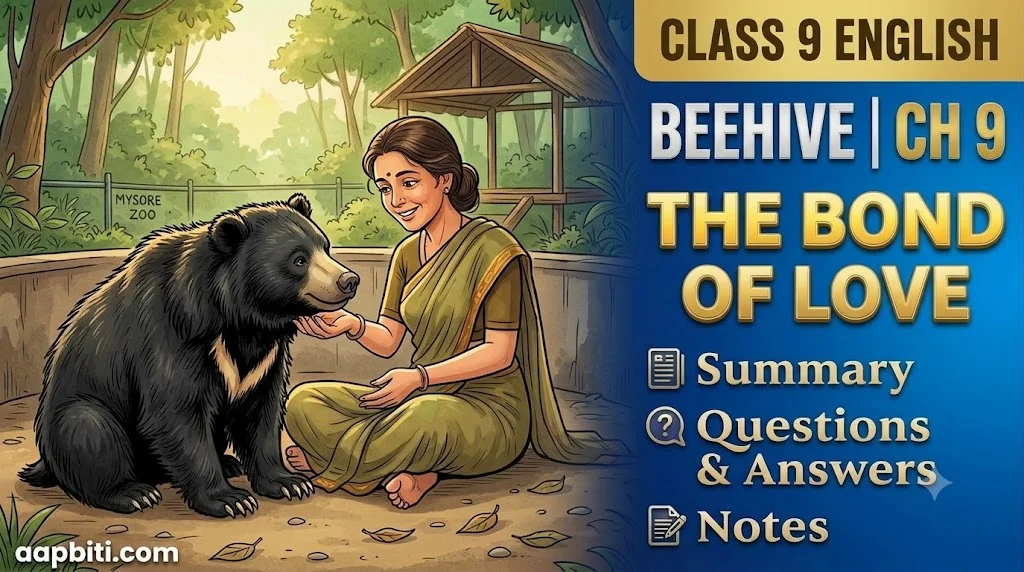
Kenneth Anderson was once travelling near Mysore with some companions when they came upon sugarcane fields, where villagers were driving away wild pigs. Suddenly a black sloth bear came out, panting in the hot sun, and one of the narrator's companions shot it on the spot. As the party watched the fallen animal, they noticed that the fur on its back was moving. It was a baby bear that had been riding on its mother's back. The narrator ran up and caught the cub after a struggle, and he took it home as a pet for his wife. "I got him for her by accident," he says.
The family named the cub Bruno. The narrator's wife loved him like a child and called him "Baba", a name for a small boy. Bruno was playful and affectionate, and he followed a regular food-chart. Twice he got into trouble. Once he ate some poison meant for rats, and he was rushed to the vet and cured with an antidote. Another time he drank nearly a gallon of old engine oil, but nothing happened to him. As he grew bigger and stronger, it became unsafe to keep him at home, and the family reluctantly sent him to a zoo. They missed him greatly, but in a sense they were relieved.
At the zoo, Bruno was sad and refused to eat the food that was given to him. When the narrator's wife visited him, Bruno recognised her even when she was a few yards away. When she ran up to him and petted him through the bars, he stood on his head in delight. Seeing this joyful reunion and Bruno's unhappiness, the zoo authorities allowed him to return home. An island was made for him in the courtyard, with everything he needed. The story ends with the family happy to have their pet back.


Bruno's Story in Order
| Stage | What happened |
|---|---|
| Rescue | Mother bear shot, baby caught and taken home |
| Home life | Named Bruno, called Baba, fed on a food-chart, playful with the family |
| Two accidents | Rat poison (cured by the vet) and engine oil (no effect) |
| Separation | Sent to a zoo because he grew too big |
| Reunion | Joyful meeting, zoo allows his return, island built at home |
NCERT Textbook Questions with Answers
Before You Read
Q. Can there be love and friendship between human beings and wild animals? Ans. Yes, there can be, if the animal is treated with care and patience. The story of Bruno shows this clearly, though wild animals also need proper space and respect for their nature.
Thinking about the Text I: Match the Headings with Paragraphs
Ans. (i) An Orphaned Cub: paragraph 3. (ii) Bruno's Food-chart: paragraph 6. (iii) An Accidental Case of Poisoning: paragraph 8. (iv) Playful Baba: paragraph 12. (v) Pain of Separation: paragraph 14. (vi) Joy of Reunion: paragraph 16. (vii) A Request to the Zoo: paragraph 18. (viii) An Island in the Courtyard: paragraph 2.
Thinking about the Text II: Answer the Following Questions
Q1. "I got him for her by accident." (i) Who says this? (ii) Who do "him" and "her" refer to? (iii) What is the incident referred to here? Ans. (i) The narrator, Kenneth Anderson, says this. (ii) "Him" refers to the baby sloth bear, Bruno, and "her" refers to the narrator's wife. (iii) While passing through the sugarcane fields near Mysore, the party saw a sloth bear, and one of the narrator's companions shot it. They then found a baby bear that had been riding on its mother's back. The narrator caught it and gave it to his wife.
Q2. "He stood on his head in delight." (i) Who does "he" refer to? (ii) Why was he delighted? Ans. (i) "He" refers to Bruno, the bear. (ii) Bruno was delighted to see the narrator's wife. He had been sad at the zoo and had refused food, but he recognised her from some yards away. When she ran up and petted him through the bars, he stood on his head in delight.
Q3. "We all missed him greatly: but in a sense we were relieved." (i) Who does "we all" stand for? (ii) Who did they miss? (iii) Why did they nevertheless feel relieved? Ans. (i) "We all" stands for the narrator, his wife and his son. (ii) They missed Bruno, whom they also called Baba. (iii) They felt relieved because Bruno was getting too big to be kept safely at home, so sending him to the zoo seemed the right thing to do.
Thinking about the Text III: 30 to 40 Words Each
Q1. On two occasions Bruno ate or drank something that should not be eaten or drunk. What happened to him? Ans. Bruno once ate poison meant for rats. He could not stand on his feet and was rushed to the vet, where he was cured with an antidote. Another time, he drank nearly a gallon of old engine oil, but it did not affect him at all.
Q2. Was Bruno a loving and playful pet? Why, then, did he have to be sent away? Ans. Yes, he was loving and playful, and everyone in the family was attached to him, especially the narrator's wife. He had to be sent away because he was growing too big and strong to be kept safely at home.
Q3. How was the problem of what to do with Bruno finally solved? Ans. Bruno was unhappy at the zoo. Seeing his sadness and his joy at meeting the narrator's wife, the zoo authorities allowed him to return home. An island was then built for him in the courtyard, keeping all his needs in mind.
Thinking about Language I: Spelling with ie and ei
Ans. The popular rule is "i before e, except after c". It works for words such as field, friend, believe, relieve and receive, ceiling. There are exceptions, for example neighbour, weight, weird and seize, so the rule is useful but not always true. Fill the blanks of the second exercise with ie or ei after checking each word in a dictionary, and find the words from the lesson in your book.
Thinking about Language II: Silent Letters
| Word | Silent letter | Word | Silent letter |
|---|---|---|---|
| knock | k | honest | h |
| wrestle | t | daughter | gh |
| walk | l | hours | h |
| wrong | w | calm | l |
| knee | k | could | l |
| half | l | sign | g |
| island | s | return, hornet, button | No clearly silent letter |
Your teacher will dictate these words, so practise writing them and underlining the silent letters.
Thinking about Language III: Using an Index
Ans. This is a self-attempt task based on the index entries printed in your textbook. Look up "bronchitis" in the index and check whether it lists subtopics such as smoking, heart failure and children, and note down the page numbers of each topic.
Thinking about Language IV: The Narrative Present
Q. Rewrite the paragraph in complete sentences. Ans. The vet and I made a dash back to the car. Bruno was still floundering about on his stumps but was clearly weakening rapidly. He was vomiting, breathing heavily, with heaving flanks and a gaping mouth. We all held him, and the vet injected the antidote, and Bruno squealed. Ten minutes later, his condition was unchanged, so the vet gave him another injection. Ten minutes after that, his breathing was less laboured, and he could move his arms and legs a little, although he still could not stand. Thirty minutes later, Bruno got up and had a great meal. He looked at us scornfully, as if to say that barium carbonate meant nothing to a big black bear like him. He was still eating. The present tense in the original gives a sense of immediacy, as in a sports commentary.
Thinking about Language V: Adverbs
Q1. Find the adverbs in the passage. Ans. The adverbs are suddenly, wantonly, unfortunately and promptly (and not in "will not shoot").
Q2(i). Complete the sentences with an adverb ending in -ly. Ans. (a) Rana does her homework carefully. (b) It rains heavily in Mumbai in June. (c) He does his work properly. (d) The dog serves his master faithfully.
Q2(ii). Choose the most suitable adverb. Ans. (a) We should never get down from a moving train. (b) I was badly in need of support after my poor performance. (c) Rita met with an accident. The doctor examined her immediately.
Thinking about Language VI: The Scrambled Story (Dictation)
Ans. Write down the dictated sentences with correct punctuation, using inverted commas for every spoken line. Then rearrange the story in this order: (1) It is a cold winter's day, and an ant brings out grains of corn to dry. (2) A hungry grasshopper sees her and asks where she got the corn. (3) The ant says that she collected it in summer and asks what the grasshopper was doing then. (4) The grasshopper says that he was too busy. (5) When asked again, he says that he was singing all day. (6) The ant replies that if he sang all summer, he can dance all winter.
Speaking
Q. "Animals also feel the pleasure of love and the pain of separation." Make a presentation giving examples from your own experience. Ans. Use a personal experience. A model: "My neighbour's dog waits at the gate every evening for his owner. When the owner went away for a week, the dog stopped eating and kept looking at the road. When he returned, the dog jumped, barked and wagged his tail for several minutes. Like Bruno, he showed that animals feel love and miss their loved ones."
Writing
Q. Pets need special care and should be kept only by people who can meet their needs. Argue for or against this statement. Ans. (In support.) Pets are living beings, not toys. A pet depends fully on its owner for food, shelter, exercise, medical care and affection. People who lack time, space or patience often neglect animals, which leads to illness and suffering. The story of Bruno shows that even a loving family had to send the bear away, because they could not meet the needs of a growing wild animal at home. Therefore, only those who understand and are ready to meet the needs of an animal should keep one. Those who want company without the responsibility should enjoy animals in sanctuaries and parks. (The second option, on snake charmers, is a self-attempt task based on your newspaper clipping.)
Extra Questions and Answers
Very Short Answer Type (1 Mark)
Q1. Who wrote "The Bond of Love"? Ans. Kenneth Anderson. Q2. What kind of animal was Bruno? Ans. A sloth bear. Q3. What did the narrator's wife call Bruno? Ans. Baba. Q4. What poison did Bruno eat? Ans. Poison meant for rats (barium carbonate). Q5. What did Bruno drink that did not harm him? Ans. Old engine oil. Q6. Where was a special place built for Bruno? Ans. An island in the courtyard of the house.
Short Answer Type (30 to 40 Words)
Q1. How did the narrator get the baby bear? Ans. A companion shot a mother sloth bear. The narrator noticed that the fur on her back moved and found a baby bear riding there. He ran up, caught the cub and took it home.
Q2. How did the narrator's wife feel when Bruno was sent to the zoo? Ans. She was very sad, because she loved Bruno like a child. She missed him badly and kept thinking about him until she saw him again.
Q3. How did Bruno behave at the zoo before his reunion? Ans. He was unhappy and refused the food given to him. His sadness showed how much he missed the family.
Q4. Why does the narrator say, "in a sense we were relieved"? Ans. They missed Bruno, but he had become too big and strong to be kept at home, so they felt that sending him away was safer.
Long Answer Type (100 to 120 Words)
Q1. Describe the bond of love between Bruno and the narrator's wife. Ans. The narrator's wife treated Bruno like her own child and called him "Baba". Bruno was playful and deeply attached to her. When he was sent to the zoo, he became sad and refused to eat, and she too was heartbroken. During her visit, Bruno recognised her from a distance, and when she petted him through the bars, he stood on his head in delight. Their reunion moved the zoo authorities, who allowed Bruno to go home. This shows that love and understanding can bridge the gap between a human being and a wild animal.
Q2. Write a character sketch of Bruno. Ans. Bruno was an orphaned sloth bear who grew up in a human family. He was playful, affectionate and full of energy. He was also very strong, as shown when he survived rat poison and drank engine oil without harm. He was deeply attached to the narrator's wife and became sad when he was separated from her, which shows his sensitivity. His size made him unsafe at home, but his love for the family never changed. His story shows that animals also have emotions and loyalty.
Important Words and Meanings
| Word | Meaning |
|---|---|
| Orphaned | Having lost one's parents |
| Wantonly | Without reason or need |
| Floundering | Struggling to move |
| Antidote | A medicine that works against poison |
| Disdainfully | With scorn or contempt |
Themes and Quick Revision
Themes: The chapter shows the emotional bond between humans and animals, the pain of separation, the responsibility of keeping animals, and the idea that wild animals have feelings.
| Memory Aid | Remember |
|---|---|
| Two accidents | Rat poison (cured) and engine oil (no effect). |
| Baba | The narrator's wife's name for Bruno. |
| Reunion | Bruno stood on his head in delight, and an island was made for him. |
Conclusion: "The Bond of Love" is a warm story that shows that love knows no boundaries. For exams, remember the paragraph matching, the three "who said it" answers, the two accidents and the language exercises on adverbs and the narrative present.

"Naina Saini is an Editorial Intern at Aapbiti, specializing in publishing and managing education-focused news articles. Operating under the direct mentorship and guidance of Shakti Rao Mani, the Product Owner of aapbiti.com, Naina is dedicated to delivering accurate, timely, and engaging academic updates. Her role focuses on keeping readers informed about educational trends, exams, admissions, and key academic policies."













Comments (0)