

My Childhood Class 9 English Beehive Chapter 6 Summary, Question Answers and Notes
Complete notes, summary, NCERT question answers, extra questions, and grammar exercises for Class 9 English Beehive Chapter 6 "My Childhood" by Dr A.P.J. Abdul Kalam. Easy explanations and revision guide.
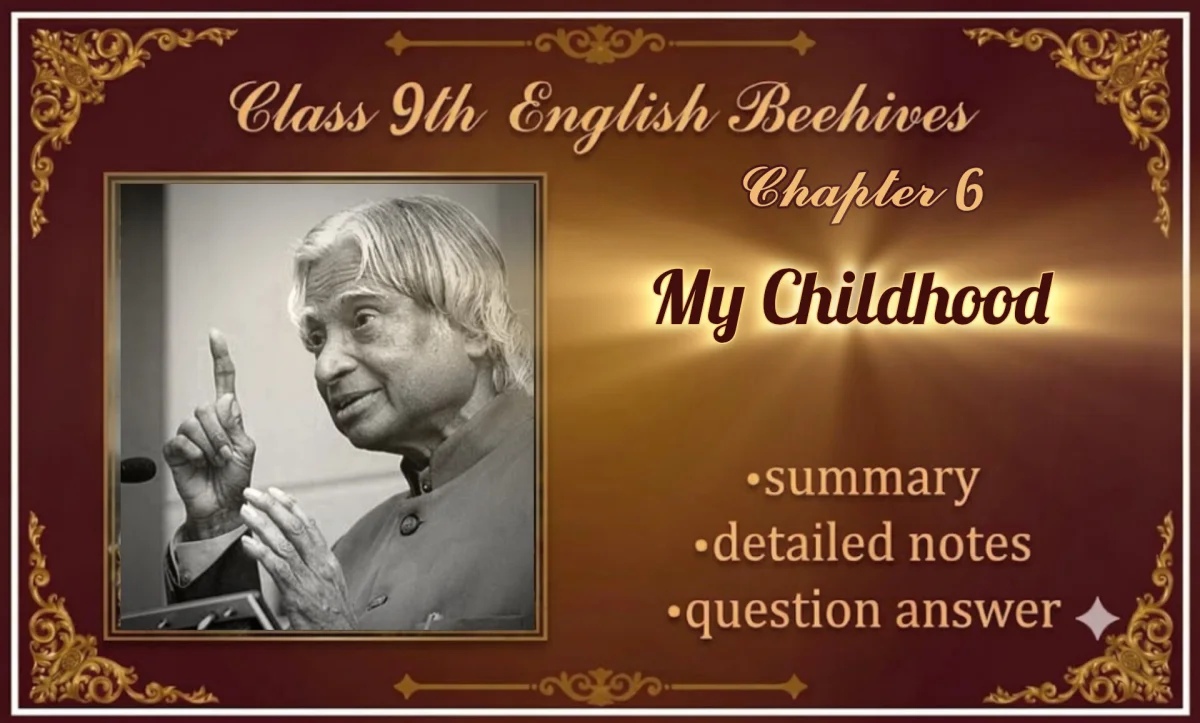


Chapter at a Glance
| Point | Detail |
|---|---|
| Author | Dr A.P.J. Abdul Kalam (from Wings of Fire) |
| Place | Rameswaram, Mosque Street |
| Parents | Jainulabdeen (father) and Ashiamma (mother) |
| Friends | Ramanadha Sastry, Aravindan and Sivaprakasan |
| Key people | Samsuddin (cousin), Jallaluddin (brother-in-law), Sivasubramania Iyer (science teacher) |
| Central idea | Love, honesty and open-mindedness can overcome social divisions |
Summary of the Chapter
Kalam was born in a middle-class Tamil family in the island town of Rameswaram. His father, Jainulabdeen, was not wealthy or highly educated, but he was wise, generous and honest, and he avoided unnecessary comforts. His mother, Ashiamma, was kind and fed many people every day. Kalam says that he had a secure childhood, both materially and emotionally. He was a short boy with undistinguished looks. From his father he inherited honesty and self-discipline, and from his mother faith in goodness and deep kindness. He had three close friends, Ramanadha Sastry, Aravindan and Sivaprakasan, who all belonged to orthodox Hindu families. They later became a priest, a transport businessman and a railway caterer.


When the Second World War began, there was a sudden demand for tamarind seeds, and Kalam collected them and sold them to a provision shop for an anna a day. His brother-in-law Jallaluddin told him stories about the war, which he tried to trace in the headlines of the newspaper Dinamani. When the train stopped halting at Rameswaram, newspaper bundles were thrown from the moving train, and Kalam's cousin Samsuddin and he collected and distributed them. This gave him his first wages, and he still remembers the surge of pride.
Rameswaram society was rigid in separating social groups, but friendship crossed these lines. In the fifth standard, a new teacher could not stand a Muslim boy sitting beside a Hindu priest's son and ordered Kalam to the last row. Both boys were hurt. When their parents learned of this, Ramanadha's father, the head priest, scolded the teacher, who then changed his attitude. Kalam's science teacher, Sivasubramania Iyer, invited him home for a meal. His wife refused to serve a Muslim boy in her ritually pure kitchen, but Iyer served him himself and dined with him. Later his wife served him with her own hands. Finally, Kalam wanted to study further in Ramanathapuram. His father supported him, quoting Kahlil Gibran, and said that children should be free to find their own path, like a seagull flying far from the shore.
Qualities Kalam Inherited
| From | Quality |
|---|---|
| Father | Honesty and self-discipline |
| Mother | Faith in goodness and deep kindness |
NCERT Textbook Questions with Answers
Before You Read: Map Question
Q. Find Dhanushkodi and Rameswaram on the map. What languages are spoken there? Ans. Both places are on the coast of Tamil Nadu. Tamil is the main language, and Kalam, his family, friends and teachers most likely spoke Tamil with one another. English may have been used in school lessons.


Thinking about the Text I: One or Two Sentences
Q1. Where was Abdul Kalam's house? Ans. His house was on Mosque Street in Rameswaram.
Q2. What do you think Dinamani is the name of? Give a reason. Ans. Dinamani is the name of a newspaper, because Kalam says that he traced the stories of the war in its headlines.
Q3. Who were Abdul Kalam's school friends? What did they later become? Ans. His friends were Ramanadha Sastry, Aravindan and Sivaprakasan. Ramanadha became the high priest of the Rameswaram temple, Aravindan went into the business of arranging transport for pilgrims, and Sivaprakasan became a catering contractor for the Southern Railways.
Q4. How did Abdul Kalam earn his first wages? Ans. During the Second World War, bundles of newspapers were thrown from the moving train at Rameswaram. Kalam helped his cousin Samsuddin to collect and distribute them, and he earned his first wages this way.
Q5. Had he earned any money before that? In what way? Ans. Yes. When the war began, tamarind seeds were in sudden demand. Kalam collected them and sold them to a provision shop on Mosque Street, earning one anna a day.
Thinking about the Text II: A Short Paragraph (About 30 Words)
Q1. How does the author describe (i) his father, (ii) his mother, (iii) himself? Ans. (i) His father, Jainulabdeen, was honest, generous and wise, though not wealthy or formally educated. He lived simply and avoided unnecessary comforts. (ii) His mother, Ashiamma, was a kind and loving woman who believed in goodness and fed many people every day. (iii) Kalam describes himself as a short boy with undistinguished looks, who had a secure and loving childhood.
Q2. What characteristics does he say he inherited from his parents? Ans. He inherited honesty and self-discipline from his father, and faith in goodness and deep kindness from his mother.
Thinking about the Text III: Two or Three Paragraphs
Q1(i). Which social groups does the author mention? Were these groups easily identifiable? Ans. He mentions Hindus, especially Brahmins, and Muslims. They were easily identifiable by their dress and appearance, since the Muslims wore caps and the Brahmins wore the sacred thread.
Q1(ii). Were they aware only of their differences, or did they also share friendships and experiences? Ans. They were not aware only of their differences, as they also shared friendships and experiences. Kalam's mother and grandmother told the children stories from the Ramayana and the life of the Prophet at bedtime. His closest friends were Hindu boys. During festivals at the pond near his house, the idols of the temple were carried in boats for the marriage ceremony, and people of all faiths watched and enjoyed the event.
Q1(iii). Can you identify people who were very aware of differences and those who tried to bridge them? Ans. The new teacher in the fifth standard, who made Kalam sit in the last row, and the science teacher's wife, who refused to serve him in her ritually pure kitchen, were conscious of the differences. Those who tried to bridge them were Sivasubramania Iyer, who served Kalam himself and ate with him, and Ramanadha Sastry's father, who corrected the teacher.
Q1(iv). Narrate two incidents that show how differences can be created and resolved. How can people change their attitudes? Ans. The first incident shows how a difference is created. A new teacher saw a Muslim boy sitting with a Hindu priest's son and sent Kalam to the back bench. Both boys were upset, and when they told their parents, the priest rebuked the teacher, who apologised and changed. The second incident shows resolution. Sivasubramania Iyer invited Kalam to dinner, and his wife refused to serve him. Iyer served him himself, and next time his wife served him with her own hands. People change their attitudes when they see goodwill and fairness in action and are taught by good examples.
Q2(i). Why did Abdul Kalam want to leave Rameswaram? Ans. He wanted to study further at the district headquarters, Ramanathapuram, as Rameswaram did not have a school for higher education.
Q2(ii). What did his father say to this? Ans. His father supported him. He said that Kalam would have to go away to grow, and he reminded his wife that children are not owned by their parents but belong to life's own longing. He compared Kalam to a seagull that flies alone, far from the shore.
Q2(iii). What do you think his words mean? Why did he speak them? Ans. His words mean that parents should love their children but allow them to think and live in their own way. He spoke them to convince Kalam's mother to let him go and to encourage Kalam to grow beyond the small town. He believed in freedom of thought.
Thinking about Language I
Q1. What things can erupt? What things can surge? Ans. Volcanoes, riots, anger, a rash and teeth can erupt. For example: "Riots erupted in the city"; "The volcano erupted"; "A pimple erupted on her face." Waves, crowds, armies, prices and emotions can surge. For example: "The waves surged against the rocks"; "The army surged forward"; "Her pride surged"; "There was a surge in prices."
Q2. What are the meanings of "trace"? Which is closest to the word in the text? Ans. "Trace" can mean to follow the course of something, to draw lines, to go back over again, to chase, to find through investigation, or to read with difficulty. The closest meaning in the text is "to find or discover through investigation".
Q3. Can you find "undistinguished" in your dictionary? What does it mean? Ans. If it is not listed, we can look up "distinguished", which means special, eminent or impressive. So "undistinguished" means ordinary or not impressive.
Thinking about Language II: Match the Phrases
Ans. (i) broke out: (c) began suddenly in a violent way. (ii) in accordance with: (f) according to a particular rule, principle or system. (iii) a helping hand: (d) assistance. (iv) could not stomach: (b) was not able to tolerate. (v) generosity of spirit: (a) an attitude of kindness, a readiness to give freely. (vi) figures of authority: (e) persons with power to make decisions.
Thinking about Language III: Prefixes un- and in-
Ans. inadequate, unacceptable, irregular, intolerant, undemanding, inactive, untrue, impermanent, unpatriotic, undisputed, inaccessible, incoherent, illogical, illegal, irresponsible, impossible.
Thinking about Language IV: Passive Voice
Ans. (1) In yesterday's competition the prizes were given away by the Principal. (2) In spite of financial difficulties, the labourers were paid on time. (3) On Republic Day, vehicles are not allowed beyond this point. (4) Second-hand books are bought and sold on the pavement every Saturday. (5) Elections to the Lok Sabha are held every five years. (6) Our National Anthem was composed by Rabindranath Tagore.
Thinking about Language V: Correct Form of the Verb
1. How Helmets Came to Be Used in Cricket. Ans. In a match against Barbados in Bridgetown, Nari Contractor was seriously injured and collapsed. In those days helmets were not worn. Contractor was hit on the head by a bouncer from Charlie Griffith. His skull was fractured. The entire team was deeply concerned. The West Indies players were worried. Contractor was rushed to hospital. He was accompanied by Frank Worrell, the Captain of the West Indies team. Blood was donated by the West Indies players. Thanks to the timely help, Contractor was saved. Nowadays helmets are routinely used against fast bowlers.
2. Oil from Seeds. Ans. Vegetable oils are made from seeds and fruits of many plants. Oil is produced from cotton seeds, groundnuts, soya beans and sunflower seeds. Olive oil is used for cooking and salad dressing. Olives are shaken from the trees and gathered up, usually by hand. The olives are ground to a thick paste which is spread onto special mats. Then the mats are layered upon the pressing machine, which gently squeezes them to produce olive oil.
Extra Questions and Answers
Very Short Answer Type (1 Mark)
Q1. Which book is "My Childhood" taken from? Ans. Wings of Fire. Q2. What was the name of Kalam's mother? Ans. Ashiamma. Q3. Who was Samsuddin? Ans. Kalam's cousin. Q4. In which class did the new teacher send Kalam to the last bench? Ans. The fifth standard. Q5. Who was Sivasubramania Iyer? Ans. Kalam's science teacher. Q6. Whom did Kalam's father quote? Ans. Kahlil Gibran.
Short Answer Type (30 to 40 Words)
Q1. Why was Kalam's childhood secure? Ans. His parents were loving, honest and caring. They gave him enough food, shelter and affection, so he felt safe both materially and emotionally.
Q2. How did the head priest react when the teacher separated the boys? Ans. Ramanadha's father, Lakshmana Sastry, called the teacher and told him firmly that he must not spread the poison of social inequality and communal intolerance. The teacher then changed.
Q3. How did Sivasubramania Iyer help Kalam? Ans. He invited Kalam to his home, served him food himself and ate with him. His example broke the social barrier and made his wife change her attitude.
Q4. What did Kalam feel about his first earnings? Ans. He felt a surge of pride, which he remembers even half a century later. It was the joy of earning money by his own effort.
Long Answer Type (100 to 120 Words)
Q1. Write a character sketch of Abdul Kalam as a boy. Ans. Kalam was a short boy with ordinary looks but a bright and hardworking mind. He was independent, as seen when he collected tamarind seeds and distributed newspapers to earn money. He was curious, since he tried to trace the war news in the newspaper. He valued friendship, because his closest friends belonged to a different religion, and he was hurt when a teacher separated them. He was determined to study further, and he was grateful to his parents and teachers. Honesty, kindness and ambition shaped his personality.
Q2. What message does "My Childhood" give about social harmony? Ans. The chapter shows that people of different faiths can live together as friends if they are open-minded. Although Rameswaram was rigid in its social groups, Kalam's friendships, his mother's bedtime stories and the shared festivals show natural harmony. The teacher's act of separating students showed prejudice, but the reactions of Ramanadha's father and Sivasubramania Iyer showed that prejudice can be corrected. The message is that love, fairness and courage can remove social barriers, and each person can change attitudes by setting a good example.
Important Words and Meanings
| Word | Meaning |
|---|---|
| Austere | Living a simple, strict life |
| Inessential | Not necessary |
| Segregation | Keeping groups apart |
| Orthodox | Strictly following traditional beliefs |
| Anna | An old Indian coin worth about six paise |
| Surge | A sudden strong rise or flow |
Themes and Quick Revision
Themes: The chapter highlights the influence of family values, the importance of honest work, communal harmony and the freedom to follow one's own path.
| Memory Aid | Remember |
|---|---|
| Two earnings | Tamarind seeds first, then newspaper bundles for the first wages. |
| Two teachers | One created a divide; Sivasubramania Iyer bridged it. |
| Father's advice | Children must grow and fly like the seagull. |
Conclusion: Kalam's story shows how love, simplicity and fairness shape a great person. For exams, remember his friends, the two earnings, the teacher incidents, his father's farewell words and the language exercises on prefixes and the passive voice.

"Naina Saini is an Editorial Intern at Aapbiti, specializing in publishing and managing education-focused news articles. Operating under the direct mentorship and guidance of Shakti Rao Mani, the Product Owner of aapbiti.com, Naina is dedicated to delivering accurate, timely, and engaging academic updates. Her role focuses on keeping readers informed about educational trends, exams, admissions, and key academic policies."














Comments (0)