

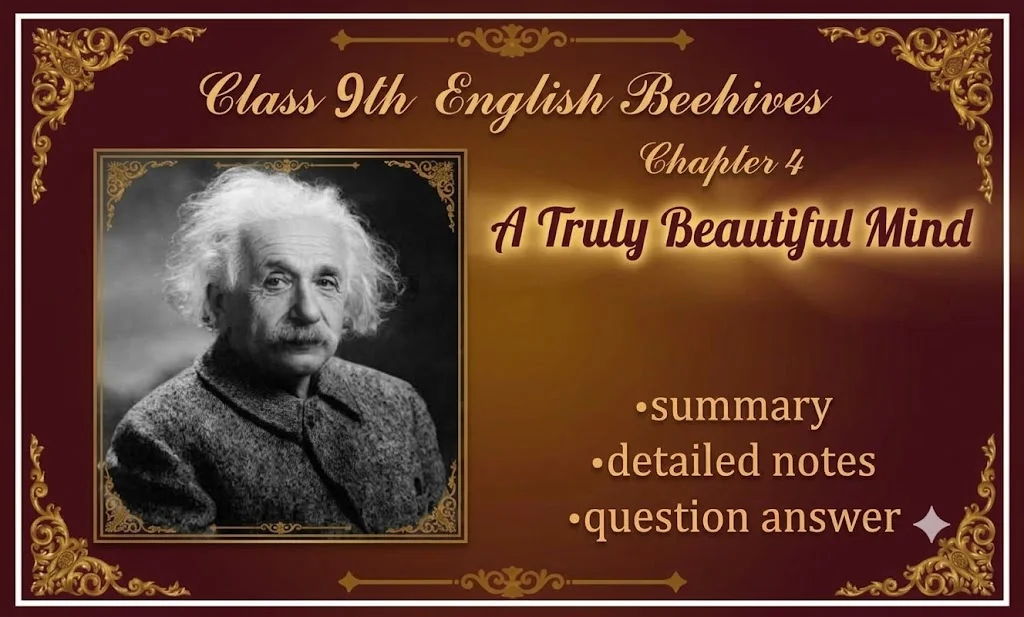
A Truly Beautiful Mind Class 9 English Beehive Chapter 4 Summary, Question Answers and Notes
Read the complete summary, NCERT solutions, extra questions, and important notes for CBSE Class 9 English Beehive Chapter 4 "A Truly Beautiful Mind" about Albert Einstein.


Chapter at a Glance
| Point | Detail |
|---|---|
| Type | Biographical sketch |
| Subject | Albert Einstein (born in Ulm, Germany) |
| Famous work | Special theory of relativity and the equation E = mc² |
| Honour | Nobel Prize in Physics |
| Central idea | A great mind is one that combines brilliance with freedom of thought and concern for humanity |
Summary of the Chapter
Albert Einstein was born in the German city of Ulm. As a child he was slow to speak and lonely, and people had strange opinions about him. His playmates thought he was boring, his headmaster said he was stupid and would never succeed in life, and his mother thought he was a freak. His mother taught him the violin, and he became a gifted amateur violinist and kept playing all his life. He attended a high school in Munich, but he disliked its strict discipline and constant arguments with teachers. When his family moved to Milan, he soon left school for good and joined them. He later chose to study in Switzerland, which was a more liberal place.


At the university in Zurich he met Mileva, a fellow student of physics. Like Einstein, she disliked the "Philistines" (narrow-minded people) around them, and he saw an ally in her. His mother did not approve of the relationship. After finishing his studies, Einstein could not find a teaching job and worked as a technical expert in a patent office. He secretly worked on his own ideas and called his desk drawer the "bureau of theoretical physics". In 1905 he published his special theory of relativity, and newspapers declared it a scientific revolution. Later he gave a new interpretation of gravity and won the Nobel Prize in Physics. The marriage with Mileva faltered, and they were divorced.
When Hitler came to power, Einstein left Germany for the United States. Five years later, the discovery of nuclear fission in Berlin put American physicists in an uproar. Einstein wrote to President Franklin Roosevelt to warn that Germany could build an atomic bomb. After the bombing of Hiroshima and Nagasaki, he was deeply shaken. He wrote to the United Nations and suggested the formation of a world government. He campaigned against the arms race and is remembered as a "world citizen". He died in 1955.
Einstein's Life in Order
| Stage | Event |
|---|---|
| Childhood | Born in Ulm, school in Munich, family moves to Milan |
| Student days | Leaves school, studies in Zurich, meets Mileva |
| Scientist | Patent office, special relativity (1905), gravity, Nobel Prize |
| Later years | Leaves Germany, letter to Roosevelt, peace campaigns, death |
NCERT Textbook Questions with Answers
Thinking about the Text
Q1. Write the number of the paragraph for each heading. Ans. (i) Einstein's equation: paragraph 9. (ii) Einstein meets his future wife: paragraph 7. (iii) The making of a violinist: paragraph 3. (iv) Mileva and Einstein's mother: paragraph 10. (v) A letter that launched the arms race: paragraph 15. (vi) A desk drawer full of ideas: paragraph 8. (vii) Marriage and divorce: paragraph 11.


Q2. Who had these opinions about Einstein? Ans. (i) "He was boring": Einstein's playmates. (ii) "He was stupid and would never succeed in life": Einstein's headmaster. (iii) "He was a freak": Einstein's mother.
Q3. Explain the reasons for the following. (i) Einstein leaving the school in Munich for good. (ii) Einstein wanting to study in Switzerland rather than in Munich. (iii) Einstein seeing in Mileva an ally. (iv) What do these tell you about Einstein? Ans. (i) He disliked the strict regimentation of the school and often argued with his teachers, so he left it for good. (ii) Switzerland was a more liberal place, and he wanted a freer atmosphere to study. (iii) Mileva, like him, was against the "Philistines", the narrow-minded people with whom he was always at odds, so he found an ally in her. (iv) These tell us that Einstein was independent, liberal and freedom-loving, and that he had his own views about life.
Q4. What did Einstein call his desk drawer at the patent office? Why? Ans. He called it the "bureau of theoretical physics". He secretly worked on his own scientific ideas while at his job and kept those papers in the drawer.
Q5. Why did Einstein write a letter to Franklin Roosevelt? Ans. He wanted to warn the American President that Germany was capable of building an atomic bomb. Such a bomb, if exploded in a port, could destroy the whole port and some of the surrounding area.
Q6. How did Einstein react to the bombing of Hiroshima and Nagasaki? Ans. He was deeply shaken by the destruction. He wrote a public letter to the United Nations and proposed the formation of a world government.
Q7. Why does the world remember Einstein as a "world citizen"? Ans. He campaigned for an end to the arms build-up and worked for peace and democracy across the world. His concern was for all humanity, not for one country alone.
Q8. Arrange the facts of Einstein's life in chronological order. Ans. (1) Einstein is born in the German city of Ulm. (2) He attends a high school in Munich. (3) His family moves to Milan. (4) Tired of the school's regimentation, he withdraws from school. (5) He joins a university in Zurich, where he meets Mileva. (6) He works in a patent office as a technical expert. (7) He publishes his special theory of relativity. (8) He provides a new interpretation of gravity. (9) He is awarded the Nobel Prize in Physics. (10) When Hitler comes to power, he leaves Germany for the United States. (11) He writes a letter to President Roosevelt warning against Germany building an atomic bomb. (12) He dies.
Thinking about Language I: Choose the Word that Can Replace the Italicised Words
Ans. (1) faltered: became weak. (2) at odds: in disagreement. (3) proclaimed: declared. (4) agitating: campaigning. (5) for good: permanently. (6) in an uproar: in a state of commotion. (7) appealed: interested.
Thinking about Language II: Participial Phrases
Ans. (1) Working round the clock, the firefighters finally put out the fire. (2) She watched the sunset above the mountain, noticing the colours blending softly into one another. (3) The excited horse pawed the ground rapidly, neighing continually. (4) Having taken the wrong train, I found myself in Bangalore, instead of Benaras. (5) Not having bathed for two days, I was desperate to get to the bathroom. (6) The stone steps, being worn down, needed to be replaced. (7) The actor received hundreds of letters from his fans, asking him to send them his photograph.
Writing a Newspaper Report
Ans. Student Unearths Einstein Manuscript. 21 August 2005. At a university in the Netherlands, an original handwritten manuscript of Albert Einstein has been unearthed. It was found by a student, Rowdy Boeynik, who was researching papers that belonged to an old friend of Einstein. The 16-page document dates back to 1924 and carries Einstein's fingerprints. It contains his work on his last theory, about the behaviour of atoms at low temperatures, now known as the Bose-Einstein condensation. The manuscript will be kept at Leyden University, where Einstein received the Nobel Prize.
Dictation
Ans. Your teacher will dictate two short anecdotes about Einstein (one with Charlie Chaplin and one about his telephone number). Write them with commas after introductory words, inverted commas around spoken words, a question mark inside the quotation and brackets for the final remark.
Extra Questions and Answers
Very Short Answer Type (1 Mark)
Q1. Where was Einstein born? Ans. In Ulm, Germany. Q2. Which instrument did Einstein play? Ans. The violin. Q3. Where did Einstein work as a technical expert? Ans. In a patent office. Q4. What is Einstein's famous equation? Ans. E = mc². Q5. To whom did Einstein write about the atomic bomb? Ans. President Franklin D. Roosevelt. Q6. Who was Mileva? Ans. A fellow physics student whom Einstein met in Zurich and later married.
Short Answer Type (30 to 40 Words)
Q1. What kind of childhood did Einstein have? Ans. Einstein had a lonely childhood. He was slow to speak, and his playmates found him boring. His headmaster thought he would never succeed, and his mother considered him a freak.
Q2. Why was Einstein unhappy at school in Munich? Ans. He felt stifled by the school's regimentation and rote methods. He often argued with his teachers, and at fifteen he left the school permanently.
Q3. What did the newspapers say about Einstein's theory? Ans. The newspapers declared his work to be a scientific revolution. His theory of relativity changed the way scientists understood space, time and energy.
Q4. What did Einstein do for peace? Ans. He campaigned against the arms build-up, wrote to the United Nations after Hiroshima and Nagasaki, and proposed a world government to prevent future wars.
Long Answer Type (100 to 120 Words)
Q1. Why is the title "A Truly Beautiful Mind" suitable for Einstein? Ans. The word "beautiful" here means more than brilliant. Einstein was a great scientist whose theory of relativity changed physics, but he was also a free thinker, a lover of music and a caring human being. He opposed rigid discipline, believed in liberty and cared about humanity. After the destruction caused by the atom bomb, he campaigned for peace and a world government. His curiosity, courage and compassion together make his mind truly beautiful, and the title suits him well.
Q2. Write a character sketch of Albert Einstein. Ans. Einstein was a curious, independent and creative person. As a child he was lonely and misunderstood, yet he never lost faith in his ideas. He disliked blind obedience and left a strict school to study in a freer place. Even while working at the patent office, he kept developing his theories secretly. He loved music and played the violin all his life. Politically aware and compassionate, he warned against nuclear weapons and worked for peace. His life shows that talent, hard work and a concern for others make a person truly great.
Important Words and Meanings
| Word | Meaning |
|---|---|
| Regimentation | Strict control and discipline |
| Liberal | Open to new ideas and freedom |
| Ally | A person who supports you |
| Philistine | A narrow-minded person who dislikes art and ideas |
| Faltered | Became weak or unsteady |
| Agitating | Campaigning actively for a cause |
Themes and Quick Revision
Themes: The chapter shows that early failure does not decide a person's future, that freedom of thought drives discovery, and that science carries moral responsibility. It also reminds us that great people are human beings with relationships, music and worries.
| Memory Aid | Remember |
|---|---|
| Three opinions | Playmates: boring. Headmaster: stupid. Mother: freak. |
| Drawer | "Bureau of theoretical physics" at the patent office. |
| Letter | Warned Roosevelt about a German atomic bomb. |
Conclusion: Einstein's life teaches us to think independently, work patiently and use knowledge for the good of the world. For exams, remember the paragraph numbers, the three opinions, the reasons for leaving school, the desk drawer, the letter to Roosevelt and the participial phrase exercise.

"Naina Saini is an Editorial Intern at Aapbiti, specializing in publishing and managing education-focused news articles. Operating under the direct mentorship and guidance of Shakti Rao Mani, the Product Owner of aapbiti.com, Naina is dedicated to delivering accurate, timely, and engaging academic updates. Her role focuses on keeping readers informed about educational trends, exams, admissions, and key academic policies."











Comments (0)