

Mijbil the Otter: Class 10 English Chapter 6 Summary, Q&A & Solutions
Master Class 10 English First Flight Chapter 6, "Mijbil the Otter" by Gavin Maxwell. This comprehensive study guide provides a simple chapter summary, character sketches, important word meanings, and detailed NCERT question-and-answer solutions to help you prepare for your CBSE board exams.
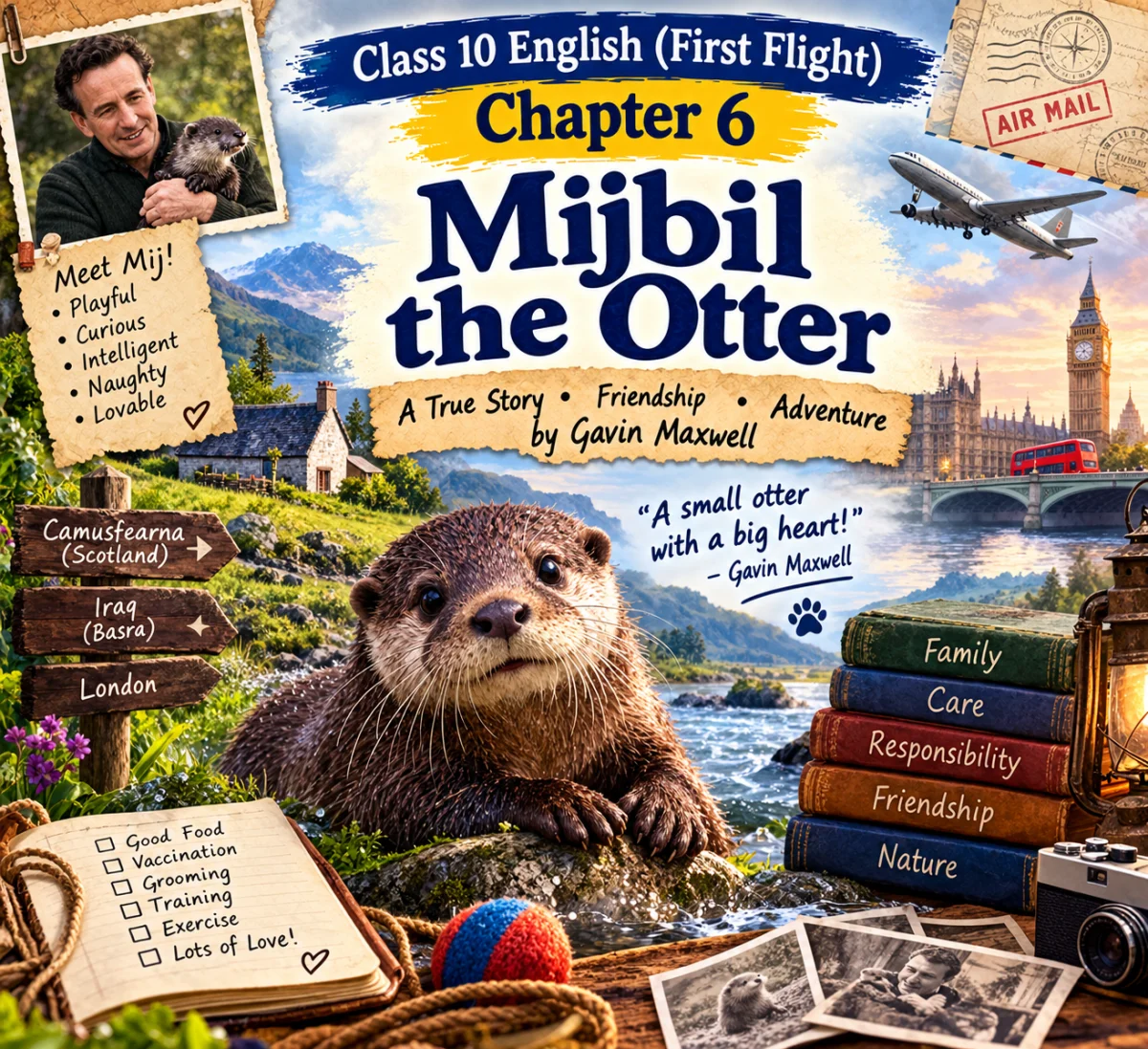


In Class 10 English (First Flight), Chapter 6 "Mijbil the Otter" by Gavin Maxwell is a delightful true-life account of an author and his pet otter. After the death of his dog Jonnie, Maxwell decides to keep an otter instead, and this chapter follows the funny and affectionate adventures of Mijbil ('Mij') from the marshes of Iraq to London. Below, the chapter is explained in simple English for Class 10 students, with a summary, word meanings, grammar solutions, important points and exam-oriented questions and answers.
Introduction to the Chapter
Gavin Maxwell lived in a cottage called Camusfearna in the West Highlands of Scotland. When his dog Jonnie died, he was too sad to think of getting another dog, but life without a pet felt lonely. This chapter, told in Maxwell's own words, describes how he came to own an otter, how he brought it to England by air, and how the whole world discovered that Mij belonged to a species previously unknown to science. The chapter's opening activity also reminds us that a pet is a serious, lifelong responsibility that needs proper food, vaccination, grooming, training, exercise and affection.


Chapter Summary in Simple Words
The chapter is divided into four parts:
| Part | What Happens |
|---|---|
| I. The Idea and the Gift | In early 1956 Maxwell travels to southern Iraq, thinking of keeping an otter at Camusfearna, which is surrounded by water. A friend tells him otters are as common as mosquitoes in the Tigris marshes. At Basra he waits for his delayed mail, and when it finally arrives, he finds two Arabs in his bedroom with a squirming sack and a note: "Here is your otter..." |
| II. Getting to Know Mij | The otter, whom he calls Mijbil, looks like a small dragon covered in mud. At first he is aloof, but soon he becomes friendly. He goes wild with joy in the bathtub, learns to turn on the taps, follows Maxwell like a dog, dribbles a ball like a footballer and juggles marbles on his belly. |
| III. The Journey to England | The airline insists that Mij travel in a box. An hour before departure, Maxwell finds that Mij has torn the box lining to shreds and hurt himself. In a rush, he puts Mij back in the box and reaches the aircraft just in time. The kind air hostess suggests he keep Mij on his knee, but Mij escapes, causing a panic ("A rat!"), until he returns to Maxwell's knee on his own. |
| IV. Life in London | For nearly a month Mij plays with toys, invents a game with a ping-pong ball and a sloping suitcase, and develops walking habits such as galloping along a school wall. Londoners cannot recognise him and guess everything from a baby seal to a brontosaur. A labourer's question, "what is that supposed to be?", amuses Maxwell the most. |
Important Point: Mij Is Like a Child and a Dog
Maxwell describes Mij almost like a small boy: he is playful, curious, easily frustrated, clingy when frightened and joyful when loved. At the same time, he treats Mij like a dog, walking him on a lead and calling him by name. Through humour and careful observation, Maxwell shows that Mij is an intelligent, friendly and fun-loving animal who needs love. The "In This Lesson" section also invites us to think about the ethics of keeping wild animals as pets and taking them away from their natural homes.
Know the Characters
| Character | Qualities |
|---|---|
| Gavin Maxwell | Animal lover, observant, humorous, patient and caring |
| Mijbil (Mij) | Intelligent, playful, curious, energetic and affectionate |
| The Air Hostess | Calm, kind, helpful and understanding; Maxwell calls her "the very queen of her kind" |
Important Word Meanings
| Word | Simple Meaning |
|---|---|
| crossed my mind | (a thought) came into my mind |
| a stone's throw | a very short distance |
| cabled | sent a message by telegraph |
| thraldom | being under the control of (old-fashioned) |
| fixation | a very strong attachment or feeling |
| christened | named |
| aloof and indifferent | keeping a distance |
| apathy | absence of interest |
| provoking | causing anger or some other reaction |
| fumbling | trying to do something in a clumsy manner |
| dreaded the prospect | was in great fear of something that would happen in the future |
| an appalling spectacle | a shocking scene |
| infuriated | very angry |
| nuzzle | to rub gently with the nose |
| engrossed | completely interested in |
| ambush | to attack suddenly from a hidden position |
| compulsive habits | habits impossible to control |
| barrage of conjectural questions | a stream of questions filled with guesses |
Important Points for Exams
- The author, Gavin Maxwell, lived at Camusfearna in the West Highlands of Scotland.
- He decided to keep an otter after the death of his dog Jonnie.
- Otters are very common in the Tigris marshes of southern Iraq and are often tamed by the Arabs.
- Mij belonged to a race previously unknown to science, named Lutrogale perspicillata maxwelli, or Maxwell's otter.
- Otters love water; they spread it everywhere and cannot bear it to be still.
- Mij learned to turn on the bathtub taps by himself.
- The airline allowed Mij only in a box not more than eighteen inches square; Mij tore its lining to shreds.
- On the aeroplane Mij escaped, caused a panic ("A rat!"), and then came back to Maxwell.
- Otters belong to the Mustelline group, along with the badger, mongoose, weasel, stoat and mink.
- Grammar covered: would and used to, noun modifiers, and phrases for quantity ("a cloud of dust").
What Do We Learn from This Chapter?
The chapter shows how deep and rewarding the bond between a human and an animal can be, and also how much responsibility it demands. It teaches us to observe animals with curiosity and affection, to treat them kindly, and to think carefully about whether wild animals should be taken from their natural homes.


Mijbil the Otter — Questions and Answers
Question 1: What 'experiment' did Maxwell think Camusfearna would be suitable for?
Answer: He thought that Camusfearna, ringed by water a stone's throw from its door, would be an excellent place to experiment with keeping an otter instead of a dog.
Question 2: Why does he go to Basra? How long does he wait there, and why?
Answer: He goes to Basra, to the Consulate-General, to collect and answer his mail from Europe. His mail had not arrived, so he cabled England and waited. After several days of failed telephone calls (the line was out of order, the exchange was closed for a holiday, and then there was another breakdown), he arranged to meet his friend in a week's time. His mail arrived five days later, so he waited for more than a week.
Question 3: How does he get the otter? Does he like it? Pick out the words that tell you this.
Answer: His friend sends the otter in a sack, carried by two Arabs, along with a note saying, "Here is your otter...". Maxwell clearly likes the otter. He describes "a thraldom to otters, an otter fixation", which shows how strongly he became attached to it.
Question 4: Why was the otter named 'Maxwell's otter'?
Answer: Mij belonged to a race of otter previously unknown to science. The zoologists named it Lutrogale perspicillata maxwelli, or Maxwell's otter, after Maxwell, who brought it to notice.
Question 5: In the beginning, the otter was (aloof and indifferent / friendly / hostile).
Answer: Aloof and indifferent. For the first twenty-four hours, he was neither friendly nor hostile and slept as far from Maxwell's bed as possible.
Question 6: What happened when Maxwell took Mijbil to the bathroom? What did it do two days after that?
Answer: Mij went wild with joy in the water, plunging, rolling and shooting up and down the bathtub, making a great splash. Two days later, he escaped from the bedroom, climbed onto the bathtub and, by himself, turned on the tap with his paws.
Question 7: How was Mij to be transported to England? What did Mij do to the box?
Answer: Since the British airline would not fly animals, Maxwell booked a flight to Paris on another airline and then to London. Mij was to travel in a box not more than eighteen inches square. Mij tore the lining of the box to shreds, and blood trickled from the airholes.
Question 8: Why did Maxwell put the otter back in the box? How do you think he felt?
Answer: There were only ten minutes left before the flight and the airport was five miles away, so he had no choice. He must have felt sad, worried and guilty at seeing his pet exhausted and hurt.
Question 9: Why does Maxwell say the air hostess was "the very queen of her kind"?
Answer: She was calm, kind and understanding when Maxwell told her about his troubles. She kept Mij's fish in a cool place, suggested that he keep Mij on his knee, and later charmingly offered to find the animal when it escaped.
Question 10: What happened when the box was opened?
Answer: Mij escaped in a flash and ran down the aircraft. People shrieked, a woman screamed "A rat!", and Maxwell's face ended up covered in curry when he dived for Mij under a passenger's legs. Mij later returned to his knee and nuzzled his face and neck.
Question 11: What game had Mij invented?
Answer: He placed a ping-pong ball at the high end of a sloping suitcase lid so that it ran down. He then dashed to the other end to ambush it, hid, sprang up, grabbed the ball and trotted back to the high end to start again.
Question 12: What are 'compulsive habits'? What are the compulsive habits of school children and of Mij?
Answer: Compulsive habits are habits that are impossible to control. School children must place their feet squarely on the centre of each paving block, touch every seventh upright of the iron railings, or pass to the outside of every second lamp post. Mij would tug Maxwell to a low school wall on the way home (never on the way out), jump on it and gallop along its whole length of thirty yards.
Question 13: What group of animals do otters belong to? What guesses did the Londoners make about Mij?
Answer: Otters belong to the Mustelline group, along with the badger, mongoose, weasel, stoat and mink. Londoners guessed that Mij was a baby seal, a squirrel, a walrus, a hippo, a beaver, a bear cub, a leopard and even a brontosaur. A labourer asked, "Here, Mister, what is that supposed to be?"
Question 14: What things does Mij do which tell you that he is an intelligent, friendly and fun-loving animal who needs love?
Answer: He learns to turn on the tap, follows Maxwell without a lead, comes when his name is called, invents games with balls and marbles, sleeps in the crook of Maxwell's knees, and rushes to him with a chitter of welcome and nuzzles his face when he is frightened on the plane.
Question 15: What are some of the things we come to know about otters from this text?
Answer: Otters are common in the Tigris marshes and are often tamed. They have scale-like coats of mud over soft chocolate-brown fur. They love water and spread it everywhere, they play by juggling small objects on their backs, and they belong to the Mustelline family.
Question 16: Complete the table: how Mij feels or thinks.
| What Mij Does | How Mij Feels or Thinks |
|---|---|
| plunges and rolls in the water, making it splosh and splash | He is wildly joyful; water must be kept on the move, and still water seems wasted and provoking to him. |
| screws the tap the wrong way | He is irritated and disappointed at the tap's failure to cooperate. |
| nuzzles Maxwell's face and neck in the aeroplane | He is relieved and happy to be reunited with Maxwell, showing recognition, welcome and affection. |
Question 17: Which statements about Maxwell's description of Mij are true?
Answer: Statements (i), (iii), (iv), (v) and (vii) are true. (i) He makes Mij seem like a small boy, as in "chittering with irritation and disappointment". (iii) He is often surprised, as when he "watched, amazed" as Mij turned the tap. (iv) The antics are comical, such as the "hippo" splashing and the curry incident. (v) He observes Mij closely, describing his games with the ball and marbles. (vii) He thinks the otter is very unusual, since it belonged to a species unknown to science. Statement (ii) is mostly untrue because he is more amused than irritated, and (vi) is untrue.
Thinking about Language — Solutions
I. Would and Used To
Answer:
- Emperor Akbar used to be fond of musical evenings. (state)
- Every evening we would / used to take long walks on the beach. (action)
- Fifty years ago, very few people used to own cars. (state)
- Till the 1980s, Shanghai used to have very dirty streets. (state)
- My uncle would / used to spend his holidays by the sea. (action)
II (1). Noun Modifiers
Answer: (i) otter → noun (ii) iron → noun (iii) Tigris → proper noun (iv) London → proper noun (v) soft velvet → adjective + noun (vi) four-footed soccer → adjective + noun
II (2). Combining Nouns and Modifiers (sample answers)
Answer: stone temple, ordinary person, birthday gifts, uncomfortable time, railroad crossing, plump physique, college girls, loud scream, first flight, invigorating coffee, panoramic view, heartbreaking farewell, incorrigible chatterbox, ridiculous subject, tremendous roar, slang expression, white handkerchief, family profession, birthday celebration, three boys.
III (1). Phrases for Quantity
Answer: (i) a portion of fried fish (ii) a pool of blood / water (iii) flakes of snow (iv) a huge heap of stones / gold (v) a gust of wind (vi) little drops of blood / water (vii) a piece of cotton / gold (viii) a pot of gold
III (2). Using 'a bit of / a piece of / a bunch of / a cloud of / a lump of'
Answer:
- (i) My teacher gave me a bit of advice.
- (ii) Can you give me a lump of clay, please?
- (iii) The piece of information you gave was very useful.
- (iv) Because of these factories, a cloud of smoke hangs over the city.
- (v) Two pieces of stone rubbed together can produce sparks of fire.
- (vi) He gave me a bunch of flowers on my birthday.
The Whole Chapter at a Glance
"Mijbil the Otter" is an amusing and affectionate account of Gavin Maxwell's pet otter, from his unusual arrival in a sack at Basra, through a dramatic aeroplane journey, to his playful life in London. The chapter's central message is that animals have feelings and personalities, and keeping a pet is a serious responsibility that calls for love and understanding. In exams, questions are commonly asked on the arrival of the otter, its behaviour with water, the air journey, the Londoners' guesses, how Maxwell describes Mij, and language exercises on would and used to, noun modifiers and quantity phrases.
For more exam preparation, you can also read our Class 9 Geography Chapter 2 notes and Class 9 Science notes on Matter in Our Surroundings . If you want to order NCERT books at home, our step-by-step guide to ordering NCERT books online will help. You can also explore our list of free AI and scientific tools for Class 6 to 12 students. For the official syllabus and textbooks, visit the official NCERT website.
Frequently Asked Questions

Vivek Kumar is an Editorial Intern at Aapbiti, specializing in publishing and managing education-focused news articles. Operating under the direct mentorship and guidance of Shakti Rao Mani, the Product Owner of aapbiti.com, Vivek is dedicated to delivering accurate, timely, and engaging academic updates. His role focuses on keeping readers informed about educational trends, exams, admissions, and key academic policies.











Comments (0)