

Madam Rides the Bus: Class 10 English Chapter 7 Summary, Q&A & Notes
Master Class 10 English First Flight Chapter 7, "Madam Rides the Bus" by Vallikkannan. This comprehensive study guide provides a simple chapter summary, character sketches, themes, word meanings, and detailed NCERT question-and-answer solutions to help you ace your CBSE board exams.
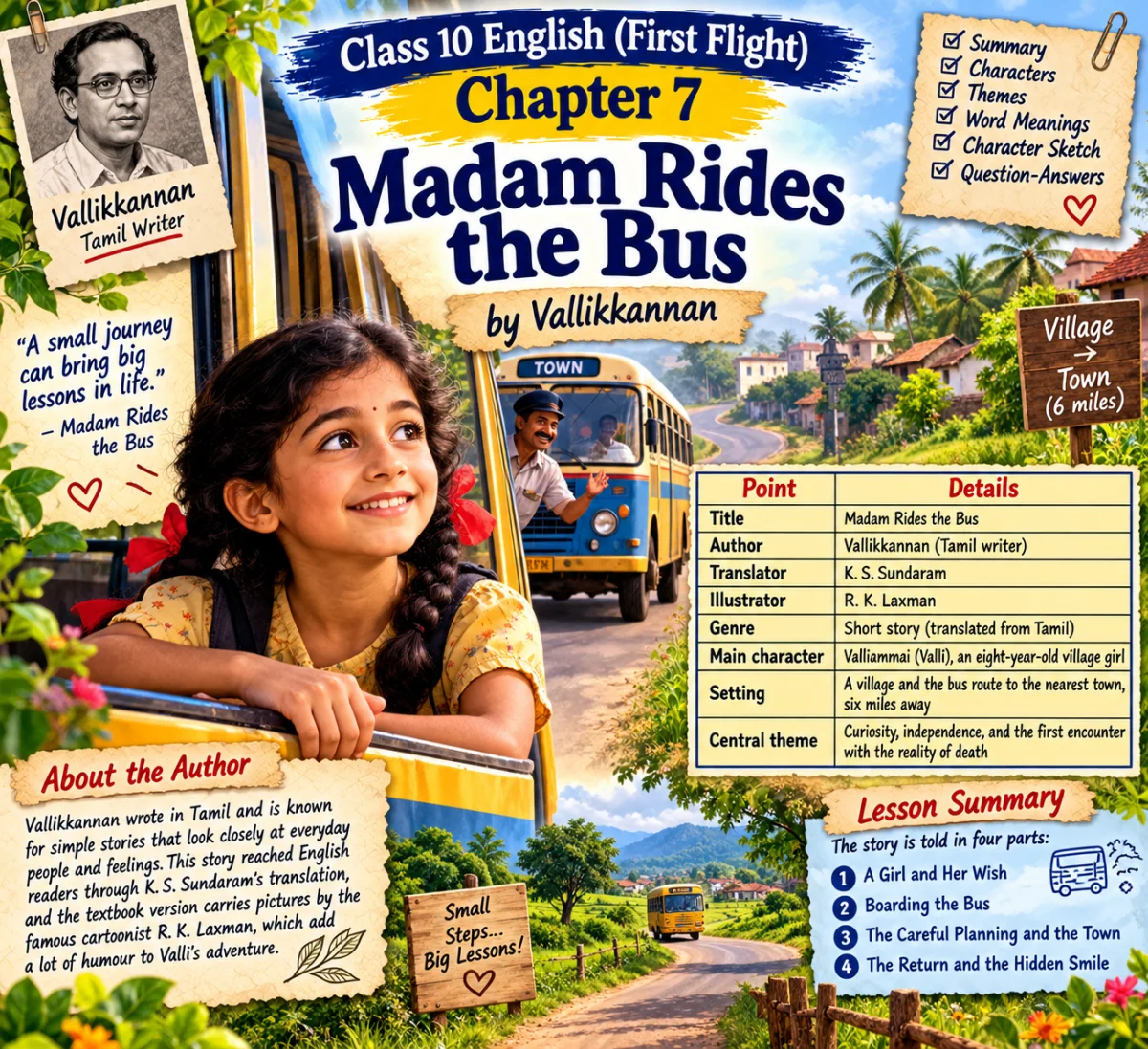


In Class 10 English (First Flight), the prose lesson "Madam Rides the Bus" by Vallikkannan tells the story of an eight-year-old girl named Valli and her first bus journey outside her village. It looks like a light, funny story, but it ends on a thoughtful note about life and death. Below, the lesson is explained in simple language — summary, characters, themes, word meanings, character sketch and exam-ready question-answers.
Lesson at a Glance
| Point | Details |
|---|---|
| Title | Madam Rides the Bus |
| Author | Vallikkannan (Tamil writer) |
| Translator | K. S. Sundaram |
| Illustrator | R. K. Laxman |
| Genre | Short story (translated from Tamil) |
| Main character | Valliammai (Valli), an eight-year-old village girl |
| Setting | A village and the bus route to the nearest town, six miles away |
| Central theme | Curiosity, independence, and the first encounter with the reality of death |



About the Author
Vallikkannan wrote in Tamil and is known for simple stories that look closely at everyday people and feelings. This story reached English readers through K. S. Sundaram's translation, and the textbook version carries pictures by the famous cartoonist R. K. Laxman, which add a lot of humour to Valli's adventure.
Summary of the Lesson
The story is told in four short parts.
Part I — A Girl and Her Wish
Valli is a curious eight-year-old with no friends her age on her street. Her favourite way to pass time is standing at the front door and watching life go by. The thing she loves most is the bus that links her village with the town every hour. Slowly, a small wish grows into a burning desire: she wants to ride that bus, just once. She listens to grown-ups talking about the journey and asks careful questions. She learns that the town is six miles away, the trip takes forty-five minutes, and the fare is thirty paise each way. She quietly plans a round trip.


Part II — Boarding the Bus
One spring afternoon Valli calls out to stop the bus and climbs in on her own. The cheerful conductor teases her by calling her "madam", and the passengers smile. Valli is shy at first, but she is also proud and does not like being treated as a child. She stands on the seat to look over the window blind and enjoys the canal, palm trees, hills and green fields. An old man warns her to sit down, and she answers back that she has paid her fare like everyone else. An elderly woman then starts asking her questions, which Valli finds irritating and rather unpleasant.
Part III — The Careful Planning and the Town
We learn how much effort went into this trip. Valli saved sixty paise by giving up sweets, toys, balloons and even a merry-go-round ride at the village fair. She also used her mother's afternoon nap as the perfect time to slip away. On the road she laughs loudly at a young cow running in front of the bus, and she is amazed at the railway crossing, the train, the shops and the crowds in town. When all other passengers get off, she stays in her seat, pays another thirty paise, and refuses even a free cold drink because she is afraid to go off alone.
Part IV — The Return and the Hidden Smile
On the way back Valli spots the same cow lying dead by the roadside, hit by a speeding vehicle. The lovely, lively animal now looks lifeless and frightening. Her excitement fades, and she no longer wants to look out of the window. Back home, she hears her mother and aunt discussing how people cannot know everything in the world, and cannot fully understand even what they do know. Valli quietly agrees — she has just learnt this lesson herself. She smiles privately because the grown-ups will never guess why.
Characters
| Character | Role and nature |
|---|---|
| Valli | Curious, determined, independent, proud, sensitive and clever |
| The conductor | Jolly, kind and playful; treats Valli with respect while joking with her |
| The elderly man | Genuinely concerned about the child's safety |
| The elderly woman | Nosy and talkative; asks too many questions |
| Valli's mother and aunt | Busy chatting; unaware of Valli's secret trip and what she has understood |
Character Sketch of Valli
- Curious: she spends hours observing the street and collects every detail about the bus journey.
- Determined and thrifty: she saves her coins patiently and ignores every temptation to spend them.
- Independent and self-respecting: she refuses help, pays her own fare and insists she is not a child.
- Shy yet bold: she is embarrassed when everyone looks at her, but still faces the whole bus.
- Cautious: she will not leave the bus alone in an unknown town.
- Sensitive and thoughtful: the sight of the dead cow shakes her and makes her grow up a little.
Themes and Message
- Longing for independence: Valli wants to be treated as a grown-up and make her own decisions.
- The world through a child's eyes: trees seem to run towards the bus and then stop; the story is told from an eight-year-old's point of view.
- Knowing versus understanding: we all know that death exists, but we truly grasp it only when we see it ourselves.
- Joy and sorrow together: the same trip brings wonder, laughter and sadness.
Important Word Meanings
| Word | Simple meaning |
|---|---|
| wistfully | with a sad, longing feeling |
| kindle | to light a fire; here, to awaken feelings |
| slang expression | informal words used within a close group |
| discreet | careful, so as not to attract attention |
| slack time | a quiet period with little work |
| haughtily | in a proud manner |
| mimicking | copying someone's voice or actions |
| repulsive | causing strong dislike |
| curtly | in a short, unfriendly way |
| drivel | silly talk |
| thriftily | spending money very carefully |
| resolutely stifled | held back firmly with determination |
| ventured out | went out boldly into an unknown place |
| thoroughfare | a busy main road |
| merchandise | goods for sale |
| spreadeagled | stretched out wide |
| haunted | kept returning to her mind |
| pokes her nose | interferes in something that is not one's concern |
Key Points for Exams
- Valli is eight years old and lives in a village; her full name is Valliammai.
- The bus runs between her village and the town every hour; the fare is thirty paise one way.
- She saves sixty paise for the return trip by resisting sweets, toys and the fair's merry-go-round.
- She slips out while her mother takes an afternoon nap.
- The conductor calls her "madam" in a playful way, and she slowly begins to enjoy the joke.
- She stays on the bus in town because she is afraid to explore alone.
- The dead cow on the return trip changes her mood and teaches her about death.
- Her final smile shows she has understood something her mother and aunt do not realise.
What Do We Learn from this Lesson?
The story shows that children notice and feel much more than adults imagine. It also reminds us that real understanding comes from experience, not just from knowing facts. Finally, it encourages curiosity, careful planning and self-confidence, while reminding us to treat young people with respect.
Madam Rides the Bus — Questions and Answers
Question 1: What was Valli's deepest desire? Which words show this?
Answer: Valli's deepest desire was to ride the bus that passed through her street, even if only once. Words such as wistfully and overwhelming desire show how strongly she wanted this, and how it grew stronger day after day.
Question 2: How did Valli plan her bus ride? What did she find out and how did she save the fare?
Answer: Valli listened to the talk of neighbours and regular passengers and asked a few careful questions. She learnt that the town was six miles away, the journey took forty-five minutes and the fare was thirty paise each way. She also worked out that she could return on the same bus by paying again. She saved sixty paise by not spending on sweets, toys and balloons, and she chose the time when her mother was asleep to leave unnoticed.
Question 3: What kind of person is Valli? (Fill in the blanks.)
Answer:
- (i) A tiny hand was raised commandingly.
- (ii) "Yes, I simply have to go to town."
- (iii) "There's nobody here who's a child."
- (iv) "I can get on by myself." … she said irritably.
- (v) "I can take care of myself."
- (vi) "I hope to see you again."
These words show that Valli is confident, independent, proud and does not like being treated as a small child.
Question 4: Why does the conductor call Valli 'madam'?
Answer: The conductor is a cheerful man who likes to joke. He sees that Valli behaves like a grown-up — she pays her own fare, boards on her own and refuses help — so he playfully calls her "madam" to humour her and to show he takes her seriously.
Question 5: Which lines show that Valli was enjoying the ride?
Answer: Valli took in everything with her eyes and stood on the seat to look over the blind at the canal, palm trees and green fields. She clapped with glee at the running cow and laughed until tears came. In town she was struck dumb with wonder at the shops and crowds. All of this shows that she was thoroughly enjoying herself.
Question 6: Why does Valli refuse to look out of the window on her way back?
Answer: On the way back she sees the same young cow lying dead by the road after an accident. The sight makes her very sad and frightened, and the memory keeps returning to her mind. Her excitement disappears, so she sits still and does not want to look outside again.
Question 7: What does Valli mean when she says she was agreeing with what her mother said about things happening without our knowledge?
Answer: Her mother says that we cannot know everything in the world, and that even what we know we may not fully understand. Valli agrees because she has just experienced this herself: she always knew that death exists, but only when she saw the dead cow did she truly understand it. This private realisation is why she smiles quietly.
Question 8: How does the story show things from an eight-year-old's point of view?
Answer: The writer describes the journey the way a child would see it. The bus seems about to "gobble up" other vehicles, and trees seem to run towards the bus and then stand helpless. Valli is thrilled by simple things like a clock, soft seats and a running cow, worries about small matters like being called a child, and reacts strongly to the cow's death. These details make us see the world through her eyes.
Question 9 (Extra): Why did Valli not get down in the town or accept a drink from the conductor?
Answer: Valli was a young girl in an unfamiliar place and felt afraid to explore on her own. She also did not have enough money for a drink and was too proud to accept a treat. This shows both her caution and her sense of self-respect.
Question 10 (Extra): What is the significance of the title "Madam Rides the Bus"?
Answer: The title uses the conductor's playful name for Valli. It points to her wish to be seen as a grown-up, and to the journey in which she acts with confidence and also grows up emotionally by facing a hard truth about life.
The Whole Lesson in a Nutshell
"Madam Rides the Bus" follows a curious village girl who secretly saves money and takes a round trip to town on the bus she has watched for months. Along the way she enjoys her independence, jokes with the conductor, marvels at the sights and refuses to be treated like a child. The sight of a dead cow on the return journey gives her an early and unforgettable lesson about death. The central message is that real understanding comes from experience, and that even a small child can feel and think deeply. In exams, questions are usually asked on Valli's character, her planning, the role of the conductor, the dead cow incident and the meaning of the ending.
For more exam preparation, you can also read our Class 9 Geography Chapter 2 notes and Class 9 Science notes on Matter in Our Surroundings. If you want to order NCERT books online, see our step-by-step guide to ordering NCERT books at home, and explore our list of free AI and scientific tools for Class 6 to 12 students. For the official textbooks and syllabus, visit the official NCERT website.
Frequently Asked Questions

Vivek Kumar is an Editorial Intern at Aapbiti, specializing in publishing and managing education-focused news articles. Operating under the direct mentorship and guidance of Shakti Rao Mani, the Product Owner of aapbiti.com, Vivek is dedicated to delivering accurate, timely, and engaging academic updates. His role focuses on keeping readers informed about educational trends, exams, admissions, and key academic policies.











Comments (0)