

Class 10 English Chapter 1 "A Letter to God" Summary, Character Sketch & NCERT Solutions
Master Chapter 1 "A Letter to God" by G. L. Fuentes from NCERT First Flight. Access a detailed summary, character sketches, irony explanation, word meanings, and complete Q&A for Class 10 exams
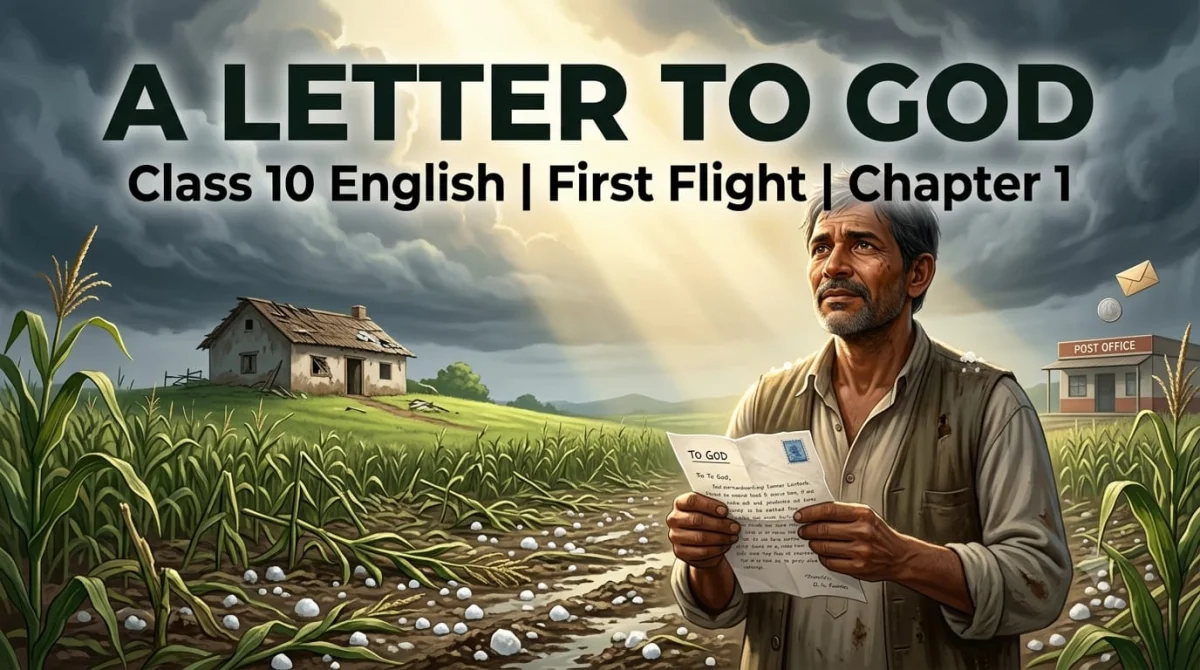


In Class 10 English (First Flight), Chapter 1 "A Letter to God" by G. L. Fuentes is a touching story about a poor farmer's unshakeable faith. When a hailstorm destroys his crops, Lencho writes a letter to God asking for a hundred pesos, and what follows is both funny and deeply moving. Below, the chapter is explained in simple English for Class 10 students, with a summary, character sketch, word meanings, grammar solutions, important points and exam-oriented questions and answers.
Introduction to the Chapter
The story begins with a simple question: "Faith can move mountains, but what should we put our faith in?" Lencho, a hard-working farmer, has complete faith in God. When a sudden hailstorm ruins his ripe cornfield, he believes only God can help him. He writes a letter addressed "To God" and posts it. The postmaster, moved by Lencho's faith, collects money and sends it, signing the reply "God". But Lencho's reaction to the money gives the story its famous ironic twist.


Chapter Summary in Simple Words
The story can be understood in five easy stages. Each stage shows how Lencho's feelings change as events unfold:
| Stage | What Happens | Lencho's Feeling |
|---|---|---|
| 1. The Hope of Rain | Lencho's house stands on a low hill. His ripe cornfield only needs rain, and clouds gather in the north-east. | Happy and hopeful |
| 2. The Hailstorm | Rain turns into hailstones that fall for an hour and destroy the whole crop. | Deep sadness and fear of hunger |
| 3. The Letter to God | Lencho writes to God asking for a hundred pesos and posts the letter himself. | Complete faith in God |
| 4. The Postmaster's Kindness | The postmaster is touched by Lencho's faith, collects money and sends only a little more than half (seventy pesos). | Postmaster: contentment and pity |
| 5. The Angry Reply | Lencho counts the money, gets angry, and writes again asking God to send the rest, but not through the mail, as post office employees are "crooks". | Anger and mistrust |
Important Point: The Irony of the Story
Irony means a situation that is the opposite of what we expect. In this story, Lencho trusts God completely but distrusts human beings. He believes God could never make a mistake, so he decides that the post office employees must have stolen the missing money. In reality, it is those very employees, led by the postmaster, who have kindly helped him by giving their own money. The man who needed help blames the people who helped him. This is the central irony of the chapter.


Know the Characters
| Character | Qualities | Shown By |
|---|---|---|
| Lencho | Hard-working, simple, deeply faithful, but naive and quick to suspect others | Working "like an animal" in the fields; writing to God; calling the post office staff crooks |
| The Postmaster | Kind, generous, humorous, sensitive to others' feelings | Collecting money for Lencho and not wanting to shake his faith |
| The Postman | Cheerful, helpful | Showing the letter to his boss; handing over the reply |
| Lencho's Wife and Sons | Supportive family who share his hope in God | Saying "Yes, God willing" and "No one dies of hunger" |
A Simple Example to Understand the Money Order
The chapter opens with an activity on sending money by post. Imagine you want to send pocket money to a friend in another town. You go to the post office counter marked "Money Order", buy a form for 50 paise, fill in the boxes in BLOCK letters, pay the clerk the amount plus charges, and take back the acknowledgement counterfoil as your record. The form has three parts: the Money Order form itself, the part for official use, and the Acknowledgement. This activity prepares you for the story, in which a post office plays the central role.
Important Word Meanings
| Word | Simple Meaning |
|---|---|
| crest | top of a hill |
| draped | covered (with cloth) |
| locusts | insects that fly in big swarms and destroy crops |
| conscience | an inner sense of right and wrong |
| peso | currency of several Latin American countries |
| amiable | friendly and pleasant |
| contentment | satisfaction |
| downpour | very heavy rain |
Important Points for Exams
- The story is written by G. L. Fuentes and is set in a lonely valley, with Lencho's house on a low hill.
- Lencho hoped for rain, but the rain turned into hailstones and destroyed the corn.
- Lencho's only hope was help from God, and he wrote a letter asking for a hundred pesos.
- The postmaster could collect only seventy pesos and signed his reply "God".
- Lencho was not surprised to receive money, but he became angry on counting it.
- Lencho blamed the post office employees, calling them "a bunch of crooks".
- Two conflicts appear in the story: humans versus nature (the hailstorm) and humans versus humans (Lencho's mistrust of the post office staff).
- Key literary devices: metaphor ("new coins", "an ox of a man", "a plague of locusts") and irony.
- Grammar covered: non-defining relative clauses and negatives for emphasis.
What Do We Learn from This Story?
The story teaches us that faith gives people strength in the hardest times, but blind faith that makes us suspicious of honest people is dangerous. It also shows the beauty of human kindness: the postmaster helped a stranger without expecting thanks. Finally, it reminds us that we should value the efforts of those who help us and not judge people hastily.
A Letter to God — Questions and Answers
Question 1: What did Lencho hope for?
Answer: Lencho hoped for rain, since his field of ripe corn needed a downpour or at least a shower to give a good harvest.
Question 2: Why did Lencho say the raindrops were like 'new coins'?
Answer: For a farmer, rain means a good crop, and a good crop means money. So Lencho compared the big drops to ten-cent pieces and the small ones to five-cent coins.
Question 3: How did the rain change? What happened to Lencho's fields?
Answer: A strong wind began to blow and the rain turned into large hailstones. The hail fell for an hour, covered the valley in white and destroyed the corn and the flowers completely.
Question 4: What were Lencho's feelings when the hail stopped?
Answer: His soul was filled with sadness. He said the hail had left nothing, even a plague of locusts would have left more, and he feared his family would go hungry that year.
Question 5: Who or what did Lencho have faith in? What did he do?
Answer: Lencho had faith in God. He wrote a letter to God asking for a hundred pesos, wrote "To God" on the envelope and posted it himself.
Question 6: Who read the letter? What did the postmaster do then?
Answer: A postman first read it and showed it to the postmaster. The postmaster was touched by Lencho's faith, so he decided to answer the letter. He collected money from his employees, friends and his own salary, and sent seventy pesos, signing the letter "God".
Question 7: Was Lencho surprised to find a letter with money in it? What made him angry?
Answer: No, he showed not the slightest surprise because of his complete confidence in God. He became angry when he counted the money and found it was less than he had asked for.
Question 8: Who does Lencho have complete faith in? Which sentences in the story tell you this?
Answer: He has complete faith in God. Sentences such as "Lencho thought only of his one hope: the help of God" and "Lencho showed not the slightest surprise on seeing the money; such was his confidence" show this.
Question 9: Why does the postmaster send money to Lencho? Why does he sign the letter 'God'?
Answer: The postmaster wanted to help Lencho and not shake his faith in God. He signed the letter "God" so that Lencho would believe the money had really come from God.
Question 10: Did Lencho try to find out who had sent the money to him? Why/Why not?
Answer: No, he did not. He was fully sure that God had sent the money, because he believed God could not make a mistake or refuse what he had asked for.
Question 11: Who does Lencho think has taken the rest of the money? What is the irony in the situation?
Answer: Lencho thinks the post office employees have stolen the rest. The irony is that these same people, especially the postmaster, had kindly given their own money to help him, yet he calls them crooks.
Question 12: Are there people like Lencho in the real world? What kind of person is he?
Answer: Yes, there are many people who trust blindly and doubt others without proof. Lencho can be described as naive and unquestioning. He is also somewhat comical, as his reaction to the money is unintentionally funny.
Question 13: There are two kinds of conflict in the story. How are they illustrated?
Answer: The first is between humans and nature: Lencho's hard work is destroyed by the hailstorm. The second is between humans themselves: Lencho distrusts the post office employees and accuses them of cheating him, though they had helped him.
Thinking about Language — Solutions
I. Names of Storms
Answer: 1. cyclone 2. gale 3. typhoon 4. tornado 5. hurricane 6. whirlwind
II. Meanings of 'hope' (Column A with Column B)
Answer:
- 1. "I hope so." → wanting something to happen (and thinking it quite possible)
- 2. "I hope you don't mind..." → showing concern that what you say should not offend the other person; a way of being polite
- 3. "new hope to HIV/AIDS sufferers" → a feeling that something good will probably happen
- 4. "hoping against hope" → wishing for something to happen, although this is very unlikely
- 5. "in the hope of speaking to her" → thinking that this would happen (it may or may not have happened)
- 6. "given up hope" → stopped believing that this good thing would happen
III. Relative Clauses (Joining Sentences)
Answer:
- 1. I often go to Mumbai, which is the commercial capital of India.
- 2. My mother, who cooks very well, is going to host a TV show on cooking.
- 3. These sportspersons, whose performance has been excellent, are going to meet the President.
- 4. Lencho prayed to God, whose eyes see into our minds.
- 5. This man, whom I trusted, cheated me.
IV. Negatives for Emphasis
Answer:
- 1. The trees lost all their leaves → "Not a leaf remained on the trees."
- 2. The letter was addressed to God himself → "It was nothing less than a letter to God."
- 3. The postman saw this address for the first time → "Never in his career as a postman had he known that address."
V. Metaphors from the Story
Answer:
| Object | Metaphor | Quality Compared |
|---|---|---|
| Cloud | Huge mountains of clouds | The mass or hugeness of mountains |
| Raindrops | New coins | Value; rain means a good crop and money |
| Hailstones | New silver coins / frozen pearls | Round shape, shine and whiteness |
| Locusts | A plague of locusts | An epidemic that spreads very rapidly and leaves many dead; locusts destroy crops in the same way |
| Lencho | An ox of a man | Strength and hard work, like an ox |
Listening Activity — Solutions
Based on Jaya's letter to Arti, the table can be completed as follows:
- The writer apologises because she has not written for a very long time.
- The writer has sent the reader her new address.
- The writer wrote the letter in the month of January (25 January 2006).
- The reason for not writing earlier: the family was busy moving to a new house.
- Sarah goes to a school called 'Little Feet'.
- Jaya is writing to Arti.
- They were last together at Bangalore, last year (2005).
The Whole Chapter at a Glance
"A Letter to God" is a short but powerful story about faith, kindness and irony. Lencho, a poor farmer, loses his crop to a hailstorm and writes to God for a hundred pesos. The postmaster, touched by his faith, collects seventy pesos and signs the reply "God". Lencho, instead of being grateful, accuses the post office staff of stealing the rest. The chapter's central message is that faith is valuable, but we must also recognise and respect the goodness of the people around us. In exams, questions are commonly asked on the irony of the story, the character of Lencho and the postmaster, the two kinds of conflict, word meanings, metaphors, relative clauses and negatives for emphasis.
For more exam preparation, you can also read our Class 9 Geography Chapter 2 notes and Class 9 Science notes on Matter in Our Surroundings . If you want to order NCERT books at home, our step-by-step guide to ordering NCERT books online will help. You can also explore our list of free AI and scientific tools for Class 6 to 12 students. For the official syllabus and textbooks, visit the official NCERT website.
Frequently Asked Questions

Vivek Kumar is an Editorial Intern at Aapbiti, specializing in publishing and managing education-focused news articles. Operating under the direct mentorship and guidance of Shakti Rao Mani, the Product Owner of aapbiti.com, Vivek is dedicated to delivering accurate, timely, and engaging academic updates. His role focuses on keeping readers informed about educational trends, exams, admissions, and key academic policies.












Comments (0)