

Class 10 English Chapter 3: Two Stories about Flying - Summary, Q&A & Notes
Complete study material for Class 10 English First Flight Chapter 3 "Two Stories about Flying." Includes simple summaries, character sketches, word meanings, and important NCERT question answers for exam preparation.
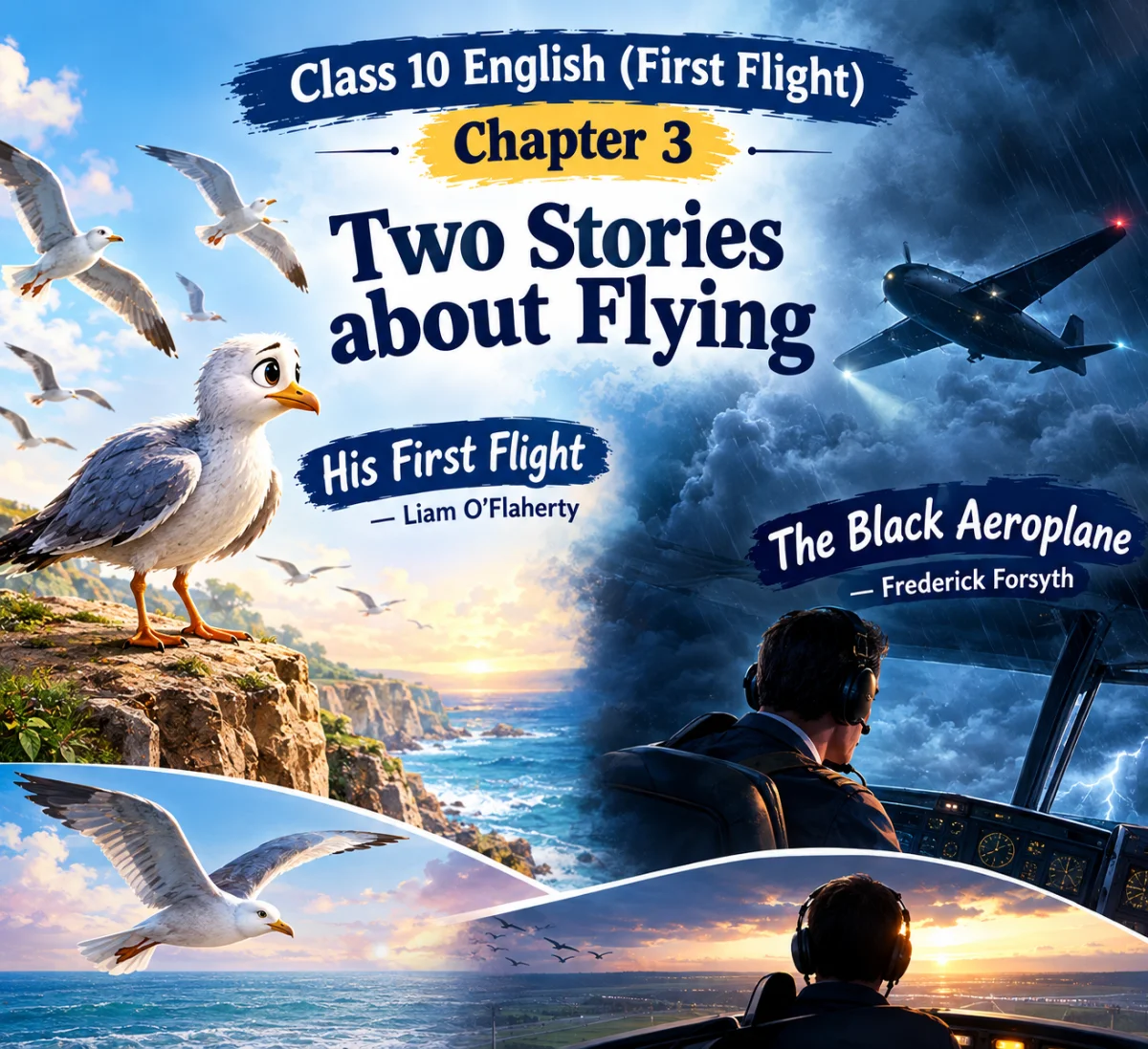


In Class 10 English (First Flight), Chapter 3 "Two Stories about Flying" brings together two very different tales on a common theme: His First Flight by Liam O'Flaherty and The Black Aeroplane by Frederick Forsyth. The first is about a young seagull who must overcome his fear to take his first flight, and the second is about a pilot lost in a storm who is guided to safety by a mysterious aeroplane. Below, both stories are explained in simple English for Class 10 students, with summaries, character sketches, word meanings, grammar solutions, important points and exam-oriented questions and answers.
Introduction to the Chapter
Since the earliest times, humans have dreamt of conquering the skies. This chapter presents two stories about flying. In the first, a young seagull is afraid to fly and must find the courage to leap off his ledge. In the second, a pilot flying home to England is caught in a terrible storm, loses all his instruments, and is led to an airport by another aeroplane that seems to vanish into thin air.


Class 10 English First Flight Chapter 3 Two Stories about Flying His First Flight and The Black Aeroplane summary, word meanings, grammar solutions and question answers explained for students.
Story I: His First Flight — Summary in Simple Words
| Stage | What Happens |
|---|---|
| 1. Alone on the Ledge | The young seagull's two brothers and sister have already flown away. He is too afraid, even though his wings are longer than his sister's. His parents scold and threaten him, but he cannot move. |
| 2. Hunger and Mockery | He watches his family teaching each other to skim the waves and catch fish. They tease him for his cowardice. He has not eaten since the previous night and is very hungry. |
| 3. The Mother's Plan | His mother holds a piece of fish and flies towards him, but stops just out of his reach, hovering in the air. |
| 4. The Leap | Maddened by hunger, he dives for the fish and falls into space. After a moment of terror, his wings spread out and he finds he can fly. |
| 5. Joy and Celebration | He soars, dives and curves with his family, lands on the sea tired and weak, and floats while his family praises him and offers him food. He has made his first flight. |
Story II: The Black Aeroplane — Summary in Simple Words
| Stage | What Happens |
|---|---|
| 1. A Calm Flight | The narrator is flying his old Dakota aeroplane from France to England at night, dreaming of his family and a good English breakfast. Paris Control gives him directions. |
| 2. The Risk | He sees huge storm clouds like black mountains. He cannot fly over them and does not have enough fuel to go around. Instead of returning to Paris, he decides to take the risk and flies into the storm. |
| 3. Lost in the Storm | Everything turns black, the aeroplane jumps and twists, and the compass, other instruments and radio all stop working. He is completely lost. |
| 4. The Mysterious Helper | Another aeroplane, with no lights on its wings, appears beside him. Its pilot waves and signals "Follow me". The narrator follows it for half an hour while his fuel runs very low. |
| 5. Safe Landing and the Mystery | The black aeroplane descends and the narrator sees the lights of a runway. He lands safely, but the other aeroplane has vanished. The woman at the control centre tells him no other aeroplane was flying that night. |
Important Point: What Do the Two Stories Have in Common?
Both stories are about overcoming fear and facing the unknown. The seagull conquers his fear when hunger pushes him to take a leap, and he discovers that he was able to fly all along. The pilot faces fear when he is lost in the storm and is rescued by a mysterious helper. The first story shows how courage grows when we try, and the second leaves us wondering about the unexplained.
Know the Characters
| Character | Qualities |
|---|---|
| The Young Seagull | Timid and fearful at first, but hungry and eager; becomes brave and joyful once he flies |
| The Seagull's Parents | Strict yet caring; they use scolding, teasing and a clever trick to make him fly |
| The Narrator (Pilot) | Eager to get home, a bit careless in taking risks, but calm and grateful when helped |
| The Black Aeroplane's Pilot | Mysterious and helpful; appears in the storm and disappears after guiding the narrator |
| The Woman in the Control Centre | Practical; she reveals that only one aeroplane was on the radar |
Important Word Meanings
| Word | Simple Meaning |
|---|---|
| ledge | a narrow horizontal shelf projecting from a wall or (here) a cliff |
| upbraiding | scolding |
| skim | to move lightly just above a surface |
| herring | a soft-finned sea fish |
| preening | making an effort to maintain feathers |
| whet | to sharpen |
| derisively | in a manner showing someone that she/he is stupid |
| dizzy | an uncomfortable feeling of spinning around and losing one's balance |
| curveting | leaping like a horse |
| banking | flying with one wing higher than the other |
Important Points for Exams
- "His First Flight" is by Liam O'Flaherty and "The Black Aeroplane" is by Frederick Forsyth.
- The young seagull was afraid because the sea seemed miles below and he felt his wings would not support him.
- Hunger, and his mother's piece of fish held just out of reach, made him take the leap.
- After the dive, he found his wings spread out and he could fly; he later landed on the sea and floated.
- The narrator of the second story was flying an old Dakota aeroplane (DS 088) from France to England.
- He took the risk of flying into the storm because he wanted to get home to his family and could not fly around it with his remaining fuel.
- Inside the storm, his compass, instruments and radio all stopped working.
- A black aeroplane with no lights guided him to a runway and then vanished.
- The woman in the control centre said no other aeroplane had been on her radar.
- Language topics: different meanings of 'black', phrases with 'fly', and words that mean 'fly'.
What Do We Learn from These Stories?
"His First Flight" teaches us that fear often stops us from discovering what we can do, and that we gain courage only by trying, even when failure is possible. "The Black Aeroplane" warns us against taking unnecessary risks, and also reminds us that some experiences in life remain a mystery. Together, they show that courage, caution and wonder all have a place in our lives.


His First Flight — Questions and Answers
Question 1: Why was the young seagull afraid to fly? Do you think all young birds are afraid to make their first flight?
Answer: The seagull was afraid because the sea looked miles below, and he felt sure his wings would not support him. Not all young birds are equally afraid; some are more timid than others, just as some children are bolder than others. A human baby also finds it a challenge to take its first steps and often falls before learning to walk.
Question 2: "The sight of the food maddened him." What does this suggest? What compelled the young seagull to finally fly?
Answer: It suggests that he was extremely hungry, having not eaten since the previous night. This hunger, along with his mother holding a piece of fish just out of reach, compelled him to dive at the fish and so he discovered that he could fly.
Question 3: Why did the seagull's father and mother threaten him and cajole him to fly?
Answer: They knew that he had the ability to fly and that he would have to learn it to survive and find his own food. They first scolded and threatened him, and later tempted him with food, so that he would overcome his fear.
Question 4: Have you ever had a similar experience, where your parents encouraged you to do something you were too scared to try?
Answer: (Sample answer) Yes. When I was learning to swim, I was afraid of deep water. My parents kept encouraging me, and when I finally tried, I realised it was not as difficult as I had thought. Students may write their own experience.
Question 5: Was your success guaranteed, or was it important for you to try regardless of the possibility of failure?
Answer: Success was not guaranteed. It was important to try, because without trying we can never learn or discover our abilities. Even if we fail the first time, each attempt helps us improve.
The Black Aeroplane — Questions and Answers
Question 1: "I'll take the risk." What is the risk? Why does the narrator take it?
Answer: The risk is flying straight into huge storm clouds, with limited fuel and the chance of losing control or crashing. The narrator takes it because he cannot fly over or around the clouds, and he wants to reach home quickly to be with his family and have breakfast.
Question 2: Describe the narrator's experience as he flew the aeroplane into the storm.
Answer: Inside the clouds everything was suddenly black and he could see nothing outside. The aeroplane jumped and twisted in the air. The compass began to spin and the other instruments and the radio stopped working. He was lost and frightened.
Question 3: Why does the narrator say, "I landed and was not sorry to walk away from the old Dakota…"?
Answer: The Dakota had taken him through a terrifying storm, its instruments had failed and its fuel was almost finished. He was relieved to have landed safely and happy to leave the aeroplane behind.
Question 4: What made the woman in the control centre look at the narrator strangely?
Answer: When he asked about the other pilot, she told him that no other aeroplane had been flying that night and that only his aeroplane had appeared on her radar. His story did not match what she knew, so she looked at him strangely and then laughed.
Question 5: Who do you think helped the narrator to reach safely?
Answer: The story leaves this open. Some may think the helper was a ghost or guardian spirit, since the aeroplane had no lights, appeared in a storm and vanished without a trace. Others may think the exhausted narrator imagined it, or that it was a real aeroplane that the radar missed. Any of these views is acceptable if supported by reasons.
Thinking about Language — Solutions
I. Meanings of 'black'
Answer:
- 1. Your hands and face are absolutely black → very dirty
- 2. gave Ratan a black look → an angry or disapproving look
- 3. blackest crimes against humanity → most evil or wicked
- 4. Harold Pinter's black comedy → comedy that treats serious or disturbing subjects in a humorous way
- 5. sell these in black → sell illegally (black market)
- 6. beaten black and blue → beaten badly, leaving bruises
II. Phrases with 'fly'
| Phrase | Meaning |
|---|---|
| 1. Fly a flag | Display a flag on a long pole |
| 2. Fly into rage | Become suddenly very angry |
| 3. Fly along | Move quickly/suddenly |
| 4. Fly high | Be successful |
| 5. Fly the coop | Escape from a place |
III. Words with the Same or Nearly the Same Meaning as 'fly'
Answer: swoop, ascend, flit, flutter, skim, dart, soar, hover, glide, flap. (Words such as sink, descend, stay, fall, float, paddle, ride, shoot, spring and sail do not describe flying with wings in this sense.)
The Whole Chapter at a Glance
"Two Stories about Flying" presents two tales of fear, courage and mystery. In His First Flight, a hungry young seagull overcomes his fear when he leaps for food and discovers he can fly. In The Black Aeroplane, a pilot takes a risk, loses all his instruments in a storm and is guided to safety by an aeroplane that no one else saw. The chapter's central message is that we often discover our strength only by trying, and that life holds mysteries beyond easy explanation. In exams, questions are commonly asked on the seagull's fear and how he overcame it, the narrator's risk and experience, the mystery of the black aeroplane, and the language exercises on 'black' and 'fly'.
For more exam preparation, you can also read our Class 9 Geography Chapter 2 notes and Class 9 Science notes on Matter in Our Surroundings . If you want to order NCERT books at home, our step-by-step guide to ordering NCERT books online will help. You can also explore our list of free AI and scientific tools for Class 6 to 12 students. For the official syllabus and textbooks, visit the official NCERT website.
Frequently Asked Questions

Vivek Kumar is an Editorial Intern at Aapbiti, specializing in publishing and managing education-focused news articles. Operating under the direct mentorship and guidance of Shakti Rao Mani, the Product Owner of aapbiti.com, Vivek is dedicated to delivering accurate, timely, and engaging academic updates. His role focuses on keeping readers informed about educational trends, exams, admissions, and key academic policies.














Comments (0)