

Class 10 English Chapter 5: Glimpses of India (Summary, Q&A & Notes)
A complete, easy-to-understand study guide for Class 10 English (First Flight) Chapter 5: "Glimpses of India". Explore detailed summaries, word meanings, textbook question-answers, and exam notes for all three parts: A Baker from Goa, Coorg, and Tea from Assam.
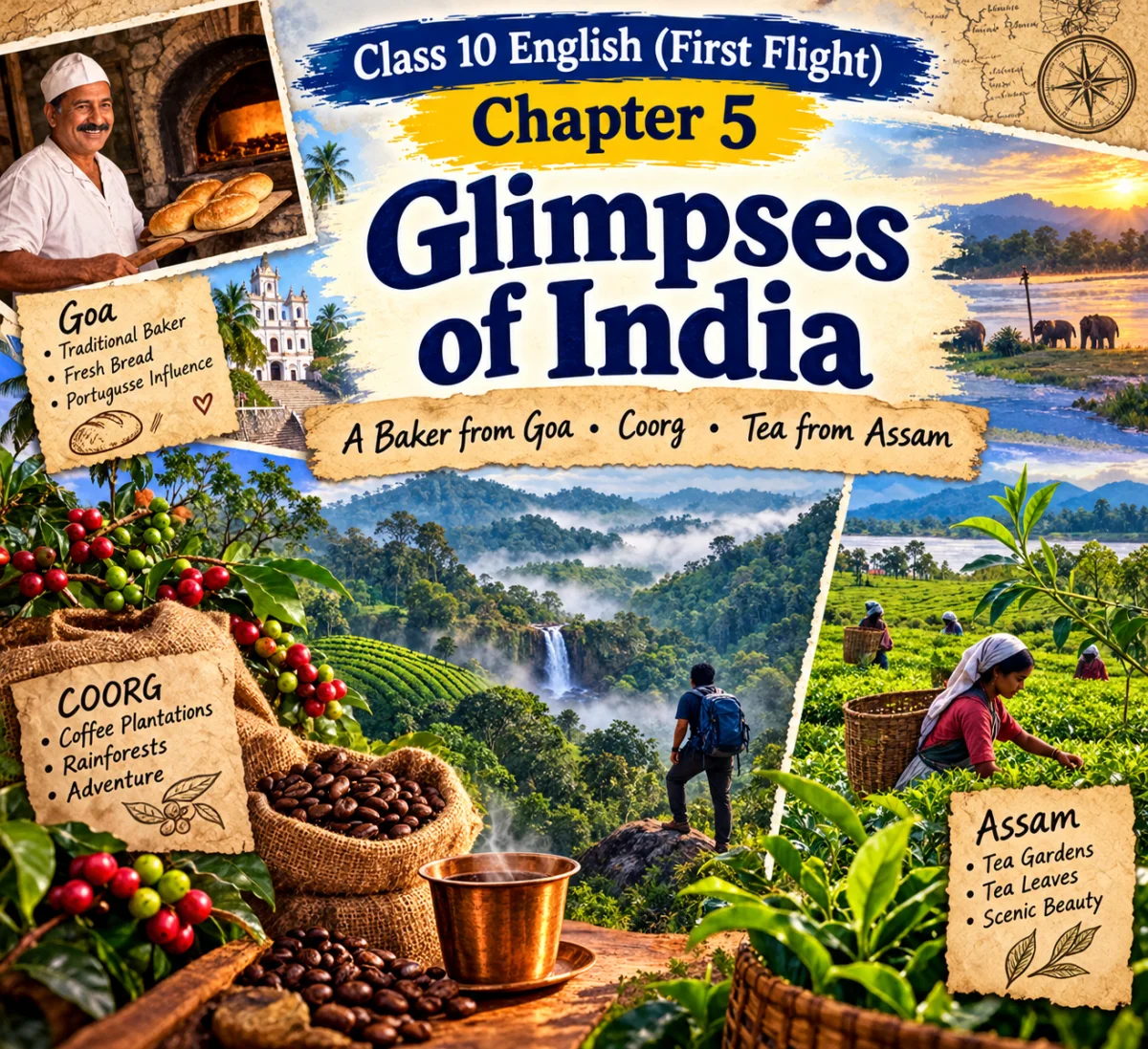


In Class 10 English (First Flight), Chapter 5 "Glimpses of India" offers three short pieces about different parts of our country: A Baker from Goa by Lucio Rodrigues, Coorg by Lokesh Abrol and Tea from Assam by Arup Kumar Datta. Together they show how varied, charming and beautiful India is. Below, all three parts are explained in simple English for Class 10 students, with summaries, word meanings, grammar solutions, important points and exam-oriented questions and answers.
Introduction to the Chapter
India is a land of great variety, and each region has its own people, food, customs and landscape. This chapter takes us on a short tour: to a Goan village where the traditional baker, the pader, still has an important place; to Coorg in Karnataka, a land of coffee, rainforests and brave people; and to Assam, the home of tea. The chapter's "Before You Read" questions also ask which parts of India show Portuguese and French influence (for example, Goa, and Pondicherry), and which grow tea (Assam, Darjeeling, the Nilgiris) and coffee (Karnataka, Kerala, Tamil Nadu).


Class 10 English First Flight Chapter 5 Glimpses of India A Baker from Goa, Coorg and Tea from Assam summary, word meanings, grammar solutions and question answers explained for students.>
Chapter Summary in Simple Words
| Part | Summary |
|---|---|
| I. A Baker from Goa | The author recalls the Portuguese days and the loaves of bread they loved. Though the Portuguese have gone, the bakers (paders) and their furnaces remain. As children, the author and friends ran to meet the baker every morning, drawn by his bamboo staff and the bread-bangles. Bread, bol, sandwiches, cakes and bolinhas are needed at weddings, engagements and festivals. The baker once wore a long frock called kabai, collected his bills monthly, and looked plump and prosperous. |
| II. Coorg | Coorg (Kodagu), the smallest district of Karnataka, lies between Mysore and Mangalore. It has rainforests, spices and coffee plantations. The proud, hospitable Kodavu people are possibly of Greek or Arabic descent, and the Coorg Regiment is among the most decorated in the Indian Army. The Kaveri river, wildlife, adventure sports, Brahmagiri hills, Nisargadhama island and the Tibetan monks at Bylakuppe make it an attractive destination. |
| III. Tea from Assam | Two school friends, Rajvir and Pranjol, travel by train to Pranjol's home in Assam. Rajvir enjoys the greenery and shares legends about tea (a Chinese emperor's boiled water and the Indian story of Bodhidharma). They reach the Dhekiabari Tea Estate managed by Pranjol's father, where Rajvir impresses Mr Barua with his knowledge about the second-flush season. |
Important Point: Nostalgia and Tone in "A Baker from Goa"
The author writes with warmth and nostalgia, fondly remembering his childhood and a way of life that is slowly changing. His tone also changes from line to line: it is nostalgic when he recalls the thud of the bamboo, hopeful when he says the son still carries on the family trade, funny when he jokes about the tiger never brushing its teeth, and matter-of-fact when he lists what bread is needed for marriages and festivals.
A Quick Look: Coorg Fact File
| Topic | Details |
|---|---|
| Location | Midway between Mysore and Mangalore, Karnataka |
| Main crop | Coffee (also spices) |
| Best season | September to March |
| Adventure sports | River rafting, canoeing, rappelling, rock climbing, mountain biking, trekking |
| Animals and birds | Elephants, macaques, Malabar squirrels, langurs, slender loris, kingfishers, mahaseer fish |
| Gateway | Madikeri, the district headquarters |
| How to reach | Nearest airports: Mangalore (135 km) and Bangalore (260 km); railheads: Mysore, Mangalore, Hassan; by road from Bangalore about 250–260 km |
Important Word Meanings
| Word | Simple Meaning |
|---|---|
| reminiscing nostalgically | thinking fondly of the past |
| heralding | announcing |
| rebuke | an expression of disapproval; a scolding |
| fragrance | scent |
| plump physique | pleasantly fat body |
| open testimony | public statement about a character or quality |
| drifted from | been carried along gently by air |
| martial | having to do with war |
| canopies | roof-like coverings that form shelters |
| mainstream | a tradition which most people follow |
| tales of valour | stories of courage and bravery, usually in war |
| laidback | relaxed; not in a hurry |
| rappelling | going down a cliff by sliding down a rope |
| panoramic view | a view of a wide area of land |
Important Points for Exams
- The Goan baker is called pader; his special dress in the old days was the kabai, a single-piece long frock.
- Bol is the sweet bread needed for marriages; cakes and bolinhas are needed for Christmas.
- The baker collected his bills at the end of the month, and accounts were recorded on a wall in pencil.
- Coorg (Kodagu) is the smallest district of Karnataka and is famous for coffee, rainforests and spices.
- The Kodavus are possibly of Greek or Arabic descent and are the only people in India allowed to carry firearms without a licence.
- General Cariappa, the first Chief of the Indian Army, was a Coorgi.
- Assam has the largest concentration of tea plantations in the world.
- Rajvir narrated two legends about tea: the Chinese emperor and Bodhidharma. Tea was first drunk in China as far back as 2700 B.C.
- The second flush (sprouting period) lasts from May to July and yields the best tea.
What Do We Learn from This Chapter?
The chapter shows that India's strength lies in its variety of cultures, occupations and landscapes. It also reminds us to respect traditional occupations like those of the pader, to appreciate our natural beauty, and to learn about the places and products that make up our country.


A Baker from Goa — Questions and Answers
Question 1: What are the elders in Goa nostalgic about?
Answer: They fondly remember the good old Portuguese days and the Portuguese loaves of bread.
Question 2: Is bread-making still popular in Goa? How do you know?
Answer: Yes. The makers of bread, the mixers, moulders and bakers, are still there, the age-old furnaces still burn, and the sound of the baker's bamboo can still be heard in some places. Sons carry on the family profession.
Question 3: What is the baker called? When would he come every day? Why did the children run to meet him?
Answer: The baker is called pader. He came twice a day: once in the morning when he set out on his round, and again when he returned after emptying his basket. The children ran to meet him because they longed for the bread-bangles, not the loaves.
Question 4: Match the following. What is a must as marriage gifts, for a party or feast, for a daughter's engagement and for Christmas?
Answer: Marriage gifts → sweet bread called bol. Party or feast → bread. Daughter's engagement → sandwiches. Christmas → cakes and bolinhas.
Question 5: What did the bakers wear in the Portuguese days and when the author was young?
Answer: In the Portuguese days they wore the kabai, a single-piece long frock reaching down to the knees. When the author was young, they wore a shirt and trousers that were shorter than full-length ones and longer than half pants.
Question 6: Who invites the comment "he is dressed like a pader"? Why?
Answer: Anyone who wears a half pant reaching just below the knees invites this comment, because the bakers used to wear trousers of that length.
Question 7: Where were the monthly accounts of the baker recorded? What does a 'jackfruit-like appearance' mean?
Answer: The accounts were recorded in pencil on some wall in the house. A 'jackfruit-like appearance' means a plump, round, well-fed body, like the bakers who looked happy and prosperous.
Question 8: Which of these statements are correct?
Answer: Correct statements: (i) The pader was an important person in the village in old times. (ii) Paders still exist in Goan villages. (v) Bread and cakes were an integral part of Goan life in the old days. The others are incorrect: the paders did not go away with the Portuguese, they no longer wear the long frock, baking was profitable "in the old days", and the paders' families do not starve.
Question 9: Is bread an important part of Goan life? How do you know this?
Answer: Yes. Marriage gifts need bol, parties and feasts need bread, engagements need sandwiches, and Christmas and other festivals need cakes and bolinhas. So the baker's furnace is essential for a village.
Question 10: What is the tone of the author in the given lines?
Answer: (i) nostalgic (ii) hopeful (iii) nostalgic (iv) funny (v) matter-of-fact (vi) matter-of-fact.
Writing Task: The author's childhood days
| Clue | Author's Childhood Days |
|---|---|
| the way bread was baked | in age-old furnaces by mixers, moulders and bakers |
| the way the pader sold bread | door to door, carrying a basket on his head and announcing himself with a bamboo staff, twice a day |
| what the pader wore | a shirt and trousers shorter than full-length and longer than half pants |
| when the pader was paid | at the end of every month |
| how the pader looked | plump, happy and prosperous |
Coorg — Questions and Answers
Question 1: Where is Coorg?
Answer: Coorg, or Kodagu, is the smallest district of Karnataka. It lies midway between Mysore and the coastal town of Mangalore.
Question 2: What is the story about the Kodavu people's descent?
Answer: According to one story, a part of Alexander's army moved south along the coast and settled in Coorg when returning became impractical. These people married locals, which explains the Kodavus' distinct martial traditions, marriage and religious rites. Others believe they are of Arab origin, because of their long black coat with an embroidered waist-belt, called kuppia.
Question 3: What are some of the things you now know about the people, main crop, sports, animals, and distance from Bangalore?
Answer:
- (i) The people: proud, fiercely independent, hospitable and martial; the Coorg Regiment is one of the most decorated in the Indian Army, and Kodavus may carry firearms without a licence.
- (ii) Main crop: coffee.
- (iii) Sports: river rafting, canoeing, rappelling, rock climbing, mountain biking and trekking.
- (iv) Animals: elephants, macaques, Malabar squirrels, langurs, slender loris, kingfishers, and mahaseer fish in the Kaveri.
- (v) Distance and route: about 250–260 km from Bangalore; the most frequented route is via Mysore, and the other is via Neelamangal, Kunigal and Chanrayanapatna. The nearest railheads are Mysore, Mangalore and Hassan.
Question 4: Find phrases from the text that have the same meaning as the italicised words.
Answer:
- (i) that tourists do not visit Coorg → "it pours enough to keep many visitors away"
- (ii) Some people say that → "As one story goes"
- (iii) are always ready to tell → "are more than willing to recount"
- (iv) get smitten by → "become converts to"
- (v) is supported by → "draws support from"
- (vi) observe you carefully → "keep a watchful eye"
Tea from Assam — Questions and Answers
Question 1: Who are Pranjol and Rajvir? Where are they going?
Answer: They are classmates at a school in Delhi. Pranjol's father manages a tea garden in Upper Assam, and Pranjol has invited Rajvir to his home for the summer vacation. They are travelling there by train.
Question 2: What legends about tea does Rajvir narrate?
Answer: One legend says that a Chinese emperor who always boiled water before drinking it once found that a few leaves from the twigs burning under the pot fell into the water, giving it a delicious flavour. The Indian legend says that the Buddhist ascetic Bodhidharma cut off his eyelids because he felt sleepy during meditation, and ten tea plants grew from them; their leaves in hot water banished sleep.
Question 3: Why was Mr Barua surprised at Rajvir's knowledge?
Answer: Rajvir knew that the second flush, or sprouting period, lasts from May to July and gives the best tea. Mr Barua was surprised because Rajvir had clearly done his homework before coming.
Thinking about Language — Solutions
I (1). Words from verb + particle
Answer: (i) downpour (ii) undergo (iii) upkeep (iv) dropout (v) walk-in
I (2). Combining verb with a word from the box
Answer: (i) throw over (overthrow) the Government (ii) a major breakthrough (iii) a bypass (iv) outlook (v) downcast
II. -ing and -ed adjectives (sample answers)
Answer: (i) thrilling/interesting (ii) interesting/exciting (iii) bored/depressed (iv) excited (v) delighted/interested (vi) tired/bored/annoyed (vii) excited/thrilled (viii) interesting/exciting
Collocations (sample answers)
| Noun | Suitable Adjectives |
|---|---|
| culture | unique culture, ancient culture |
| monks | ancient monks, serious monks |
| surprise | sudden surprise, unforgettable surprise, terrible surprise |
| experience | unique experience, terrible experience, unforgettable experience, wide experience |
| weather | terrible weather, sudden change in weather |
| tradition | ancient tradition, unique tradition |
Completing the phrases from the text
Answer: (i) tales of valour (also adventure, woe) (ii) coastal town (also city, area) (iii) a piece of heaven (also cake, land) (iv) evergreen rainforests (also trees, forests) (v) coffee plantations (also tea, rubber) (vi) rope bridge (also foot, wooden) (vii) wild elephants (also animals, flowers)
The Whole Chapter at a Glance
"Glimpses of India" gives us three snapshots of our country: the traditional pader of Goa, the beautiful coffee country of Coorg, and the tea gardens of Assam. The chapter's central message is that India's richness lies in its variety of people, traditions and landscapes. In exams, questions are commonly asked on the pader and his importance, the author's tone, the people and attractions of Coorg, the legends of tea, and language exercises on collocations, words made from verbs and particles, and -ing/-ed adjectives.
For more exam preparation, you can also read our Class 9 Geography Chapter 2 notes and Class 9 Science notes on Matter in Our Surroundings . If you want to order NCERT books at home, our step-by-step guide to ordering NCERT books online will help. You can also explore our list of free AI and scientific tools for Class 6 to 12 students. For the official syllabus and textbooks, visit the official NCERT website.
Frequently Asked Questions

Vivek Kumar is an Editorial Intern at Aapbiti, specializing in publishing and managing education-focused news articles. Operating under the direct mentorship and guidance of Shakti Rao Mani, the Product Owner of aapbiti.com, Vivek is dedicated to delivering accurate, timely, and engaging academic updates. His role focuses on keeping readers informed about educational trends, exams, admissions, and key academic policies.











Comments (0)