

Class 10 English Chapter 2: Nelson Mandela - Long Walk to Freedom (Summary, Q&A, and Notes)
A comprehensive and easy-to-understand study guide for CBSE Class 10 English First Flight Chapter 2, "Nelson Mandela: Long Walk to Freedom." This page provides a simplified summary, important word meanings, NCERT textbook question-answers, grammar solutions, and key exam points to help students prepare effectively.
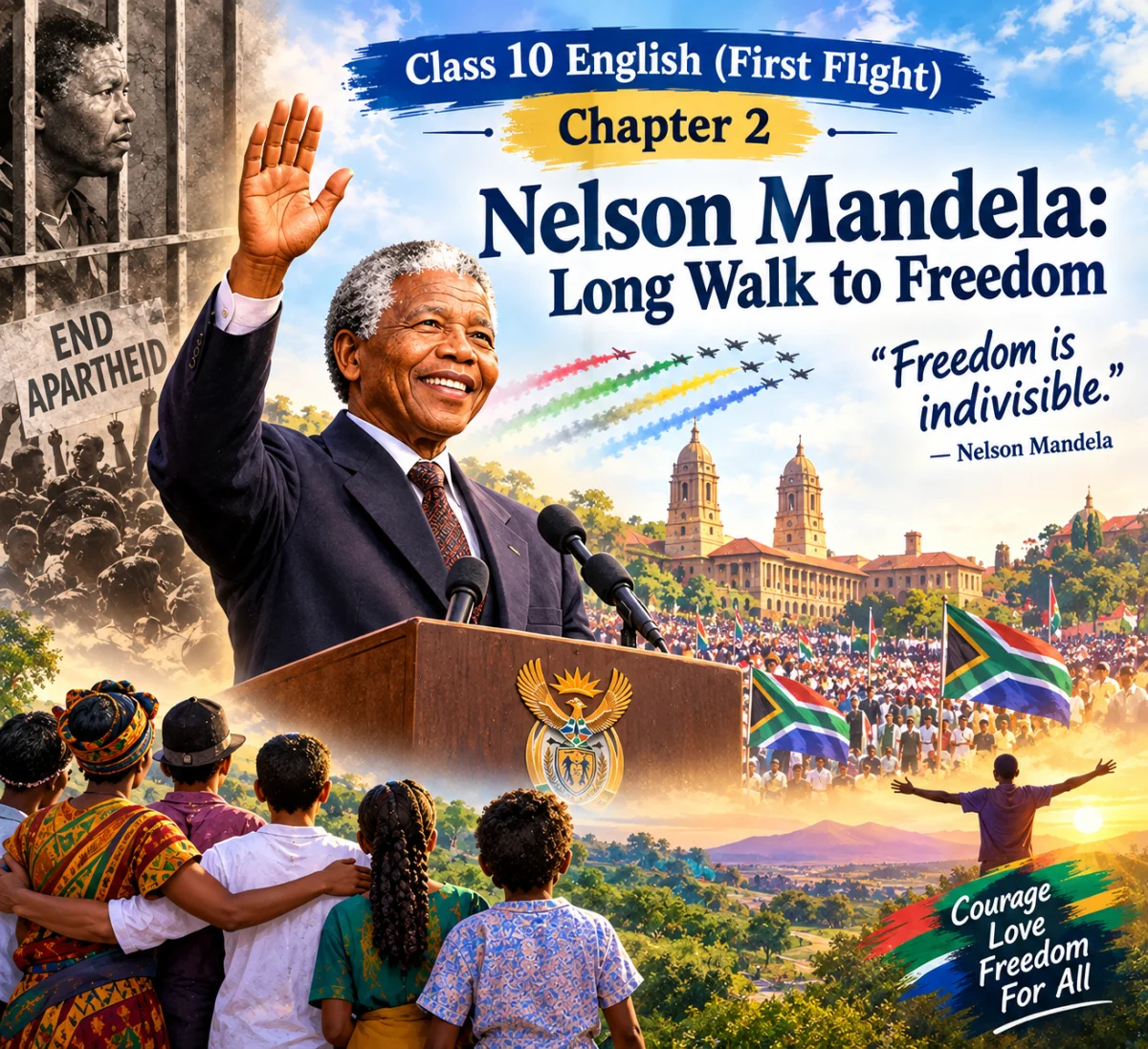


In Class 10 English (First Flight), Chapter 2 "Nelson Mandela: Long Walk to Freedom" is an extract from the autobiography of Nelson Rolihlahla Mandela. In it, Mandela describes the day of his inauguration as the first black President of South Africa on 10 May 1994, and shares his thoughts on courage, freedom, love and hatred. Below, the chapter is explained in simple English for Class 10 students, with a summary, word meanings, grammar solutions, important points and exam-oriented questions and answers.
Introduction to the Chapter
'Apartheid' was a political system in South Africa that separated people according to their race and gave special power to the white minority. Mandela and his party, the African National Congress (ANC), fought against it for a lifetime, and Mandela spent thirty years in prison. In 1994, the first democratic elections were held and Mandela became President. This chapter takes us to the inauguration ceremony in Pretoria and then moves into Mandela's thoughts on what freedom really means.


Class 10 English First Flight Chapter 2 Nelson Mandela Long Walk to Freedom summary, word meanings, grammar solutions and question answers explained for students.
Chapter Summary in Simple Words
The chapter can be understood through five main parts:
| Part | What Mandela Describes |
|---|---|
| 1. The Ceremony | On 10 May, in the sandstone amphitheatre of the Union Buildings in Pretoria, leaders from many countries gathered. A place once known as the seat of white supremacy became a "rainbow gathering" for South Africa's first democratic, non-racial government. |
| 2. The Oath and the Speech | Mr de Klerk and Thabo Mbeki were sworn in as deputy presidents, then Mandela pledged to uphold the Constitution. In his speech he spoke of a common victory for justice, peace and human dignity, and promised freedom from poverty and discrimination. |
| 3. The Air Show and the Anthems | Jets and helicopters flew over the Union Buildings, showing the army's loyalty to democracy. Generals who would once have arrested Mandela now saluted him. Two anthems were sung, one by blacks and one by whites. |
| 4. Thoughts on History and Courage | Mandela felt overwhelmed with a sense of history. He paid tribute to the brave freedom fighters who came before him, and explained that courage is not the absence of fear but the triumph over it. He also said that love comes more naturally to people than hate. |
| 5. The Meaning of Freedom | Mandela explains how his idea of freedom grew from personal freedom as a boy to the freedom of all his people, and finally to the freedom of the oppressor as well. |
Important Point: Mandela's Idea of Freedom
Mandela believed that freedom is "indivisible", which means it cannot be divided. If even one person is not free, no one is truly free. He also believed that the oppressor needs to be liberated as much as the oppressed, because a man who takes away another man's freedom is himself a prisoner of hatred, prejudice and narrow-mindedness. This is the heart of the chapter.


A Simple Way to Understand "Twin Obligations"
Mandela says that every person has two duties: one towards his family (parents, wife and children) and another towards his people, community and country. In a fair society, a person can fulfil both. But in apartheid South Africa, a black man who tried to serve his people was forced to leave his home and live a secret life of rebellion, which Mandela calls a "twilight existence". This is why he could not fulfil his duties as a son, brother, husband and father.
Important Word Meanings
| Word | Simple Meaning |
|---|---|
| besieged by | surrounded closely by |
| amphitheatre | a roofless building with rows of seats rising in steps |
| confer | to give (a formal word) |
| emancipation | freedom from restriction |
| deprivation | state of not having one's rightful benefits |
| discrimination | being treated differently or unfavourably |
| spectacular array | an impressive display |
| not unmindful of | conscious of; aware of |
| chevron | a pattern in the shape of a V |
| despised | had a very low opinion of |
| wrought | done, achieved (old-fashioned word) |
| profound | deep and strong |
| resilience | the ability to deal with hardship and recover from it |
| inclinations | natural tendencies of behaviour |
| illusion | something that appears to be real but is not |
| transitory | not permanent |
| curtailed | reduced |
| prejudice | a strong dislike without any good reason |
Important Points for Exams
- The inauguration took place on 10 May 1994 at the Union Buildings in Pretoria, with guests from more than 140 countries.
- Mandela's daughter Zenani accompanied him at the ceremony.
- Mr de Klerk became second deputy president and Thabo Mbeki became first deputy president.
- Two anthems were sung: 'Nkosi Sikelel' iAfrika' and 'Die Stem', the old anthem of the Republic.
- The new South African flag has the colours black, red, green, blue and gold.
- Mandela named brave freedom fighters such as Oliver Tambo, Walter Sisulu, Chief Luthuli, Yusuf Dadoo, Bram Fischer and Robert Sobukwe.
- According to Mandela, courage is not the absence of fear but the triumph over it.
- He believed that no one is born hating, and that people who learn to hate can be taught to love.
- Mandela says that "man's goodness is a flame that can be hidden but never extinguished".
- Grammar covered: noun forms of verbs, 'the' with proper names, idiomatic expressions and contrast.
What Do We Learn from This Chapter?
The chapter teaches us that real freedom means dignity and equality for everyone, not just for ourselves. It shows that courage is overcoming fear, that hatred is learned and can be unlearned, and that great leaders emerge from great hardship. It also reminds us that a society becomes strong only when it frees both the oppressed and the oppressor from prejudice.
Nelson Mandela: Long Walk to Freedom — Questions and Answers
Before You Read: Which country had apartheid until very recently?
Answer: (ii) South Africa.
Activity: Match the expressions in Column A with their meanings.
Answer:
- (i) A rainbow gathering of different colours and nations → a beautiful coming together of various peoples, like the colours in a rainbow
- (ii) The seat of white supremacy → the centre of racial superiority
- (iii) Be overwhelmed with a sense of history → feel deeply emotional, remembering and understanding all the past events that have led up to the moment
- (iv) Resilience that defies the imagination → a great ability (almost unimaginable) to remain unchanged by suffering
- (v) A glimmer of humanity → a sign of human feeling (goodness, kindness, pity, justice)
- (vi) A twilight existence → a half-secret life, like a life lived in the fading light between sunset and darkness
Question 1: Where did the ceremonies take place? Can you name any public buildings in India made of sandstone?
Answer: The ceremonies took place in the sandstone amphitheatre formed by the Union Buildings in Pretoria. In India, the Red Fort, Rashtrapati Bhavan and Humayun's Tomb are well-known buildings made of sandstone.
Question 2: How is 10 May an 'autumn day' in South Africa?
Answer: South Africa lies in the Southern Hemisphere, where the seasons are the opposite of those in the Northern Hemisphere. So when it is spring in India in May, it is autumn in South Africa.
Question 3: What does Mandela mean by "an extraordinary human disaster"? What is the "glorious human achievement"?
Answer: The "extraordinary human disaster" is the system of apartheid, which caused suffering for a very long time. The "glorious human achievement" is the end of apartheid and the birth of a free, democratic, non-racial South Africa.
Question 4: What does Mandela thank the international leaders for?
Answer: He thanks them for coming to take possession, together with the people of South Africa, of what he calls a common victory for justice, for peace and for human dignity.
Question 5: What ideals does he set out for the future of South Africa?
Answer: He pledges to free all people from poverty, deprivation, suffering, and gender and other discrimination. He also declares that the land will never again experience the oppression of one by another, and he wishes that freedom should reign.
Question 6: What do the military generals do? How has their attitude changed, and why?
Answer: The generals saluted Mandela and pledged their loyalty to him. Not many years earlier they would have arrested him. Their attitude has changed because a new government has been freely and fairly elected, and the army now supports democracy.
Question 7: Why were two national anthems sung?
Answer: One anthem, 'Nkosi Sikelel' iAfrika', was sung by blacks and the other, 'Die Stem', by whites. Singing both showed unity and the coming together of the two communities in the new nation.
Question 8: How does Mandela describe the systems of government in his country in the first and the final decade of the twentieth century?
Answer: In the first decade, white people built a system of racial domination against dark-skinned people, one of the harshest and most inhuman societies the world has known. In the final decade, that system was overturned and replaced by one that recognised the rights and freedoms of all people, regardless of skin colour.
Question 9: What does courage mean to Mandela? Which does he think is natural, to love or to hate?
Answer: To Mandela, courage is not the absence of fear but the triumph over it. The brave man is the one who conquers his fear. He thinks love is more natural to the human heart, because people must learn to hate, and what can be learned can also be unlearned.
Question 10: What "twin obligations" does Mandela mention?
Answer: The first is the obligation to one's family: parents, wife and children. The second is the obligation to one's people, community and country.
Question 11: What did being free mean to Mandela as a boy and as a student? How does he contrast "transitory freedoms" with "basic and honourable freedoms"?
Answer: As a boy, freedom meant running in the fields, swimming in the stream, roasting mealies and riding bulls, as long as he obeyed his father and tribal customs. As a student, it meant staying out at night, reading what he pleased and going where he chose. These were temporary freedoms. The basic and honourable freedoms are lasting ones: achieving one's potential, earning one's living, marrying and having a family, and not being obstructed in a lawful life.
Question 12: Does Mandela think the oppressor is free? Why/Why not?
Answer: No. He says the oppressor is a prisoner of hatred, locked behind the bars of prejudice and narrow-mindedness. Both the oppressed and the oppressor are robbed of their humanity.
Question 13: Why did such a large number of international leaders attend the inauguration? What did it signify the triumph of?
Answer: They came to honour the end of apartheid and the birth of a democratic nation. The ceremony signified the triumph of justice, equality and human dignity over racial discrimination.
Question 14: What does Mandela mean when he says he is "simply the sum of all those African patriots" who had gone before him?
Answer: He means that his achievement is not his alone. It is the result of the sacrifices, courage and struggle of countless freedom fighters before him, and he carries their work forward.
Question 15: Would you agree that the "depths of oppression" create "heights of character"? How does Mandela illustrate this?
Answer: Yes. Mandela shows that the cruelty of apartheid produced extraordinary leaders such as Oliver Tambo, Walter Sisulu and Chief Luthuli, who had great courage, wisdom and generosity. Other examples include Mahatma Gandhi, who rose to greatness during India's struggle against British rule.
Question 16: How did Mandela's understanding of freedom change with age and experience?
Answer: As a boy, he thought he was free. As a student, he wanted freedom only for himself. As a young man in Johannesburg, he wanted the basic freedoms to earn a living and have a family. Later, he realised that his people were not free either, so he joined the ANC and fought for everyone's freedom. Finally, he understood that even the oppressor must be freed from hatred.
Question 17: How did Mandela's 'hunger for freedom' change his life?
Answer: It transformed a frightened young man into a bold one, a law-abiding attorney into a criminal in the eyes of the state, a family-loving husband into a man without a home, and a life-loving man into one who lived like a monk.
Thinking about Language — Solutions
I (1). Noun–Verb Pairs from the Text
| Noun | Verb |
|---|---|
| formation | form |
| government | govern |
| inauguration | inaugurate |
| installation | install |
| domination | dominate |
| oppression | oppress |
| rebellion | rebel |
| constitution | constitute |
| obligation | oblige |
I (2). Fill in the Blanks with Noun Forms
Answer: contribution, assistance, subjugation, humiliation, imprisonment, resistance.
II. Using the Definite Article with Names
Answer:
- 1. Mr Singh invites film stars of the type of Amitabh Bachchan and Shah Rukh Khan, that is, very famous celebrities.
- 2. Madhuri Dixit is considered as great an actress in our times as Madhubala was in hers.
- 3. History is not only about great conquerors like Alexander, Napoleon and Hitler, but also about ordinary people.
III. Idiomatic Expressions
Answer: 1 → (i) had not forgotten; was aware of the fact. 2 → (iii) felt that we could not endure the suffering any longer. 3 → (ii) help me continue to live in hope in this very difficult situation. 4 → (i) earning enough money to live on.
Writing Section — Solutions
I. Completing the Sentences
Answer:
- 1. It requires such depths of oppression (v) to create such heights of character.
- 2. Courage was not the absence of fear (iii) but the triumph over it.
- 3. The brave man is not he who does not feel afraid (iv) but he who conquers that fear.
- 4. If people can learn to hate (i) they can be taught to love.
- 5. I was not born with a hunger to be free. (ii) I was born free.
II. Contrasts in the Text
Answer:
- 1. For decades the Union Buildings had been the seat of white supremacy, and now it was the site of a rainbow gathering of different colours and nations.
- 2. ...not so many years before they would not have saluted but arrested me.
- 3. Although that day neither group knew the lyrics..., they would soon know the words by heart. (signal word: although)
- 4. My country is rich in the minerals and gems that lie beneath its soil, but its greatest wealth is its people.
- 5. The Air Show was not only a display of pinpoint precision and military force, but a demonstration of the military's loyalty to democracy.
- 6. ...transformed a frightened young man into a bold one, drove a law-abiding attorney to become a criminal, turned a family-loving husband into a man without a home.
The Whole Chapter at a Glance
"Nelson Mandela: Long Walk to Freedom" is a powerful account of a historic day and the thoughts behind it. Mandela describes the inauguration of South Africa's first democratic, non-racial government, pays tribute to the many freedom fighters who made it possible, and explains that true freedom means dignity and equality for all, including the freedom of the oppressor from hatred. In exams, questions are commonly asked on the inauguration, the two anthems, courage, the twin obligations, the stages of Mandela's understanding of freedom, word meanings, noun forms, the use of 'the' with proper names and contrast sentences.
For more exam preparation, you can also read our Class 9 Geography Chapter 2 notes and Class 9 Science notes on Matter in Our Surroundings . If you want to order NCERT books at home, our step-by-step guide to ordering NCERT books online will help. You can also explore our list of free AI and scientific tools for Class 6 to 12 students. For the official syllabus and textbooks, visit the official NCERT website.
Frequently Asked Questions

Vivek Kumar is an Editorial Intern at Aapbiti, specializing in publishing and managing education-focused news articles. Operating under the direct mentorship and guidance of Shakti Rao Mani, the Product Owner of aapbiti.com, Vivek is dedicated to delivering accurate, timely, and engaging academic updates. His role focuses on keeping readers informed about educational trends, exams, admissions, and key academic policies.









Comments (0)