Class 10 English Chapter 9 "The Proposal" Summary & Notes
Master Class 10 English First Flight Chapter 9 "The Proposal" by Anton Chekhov. Read a simple summary, character analysis, themes, word meanings, and NCERT question answers.
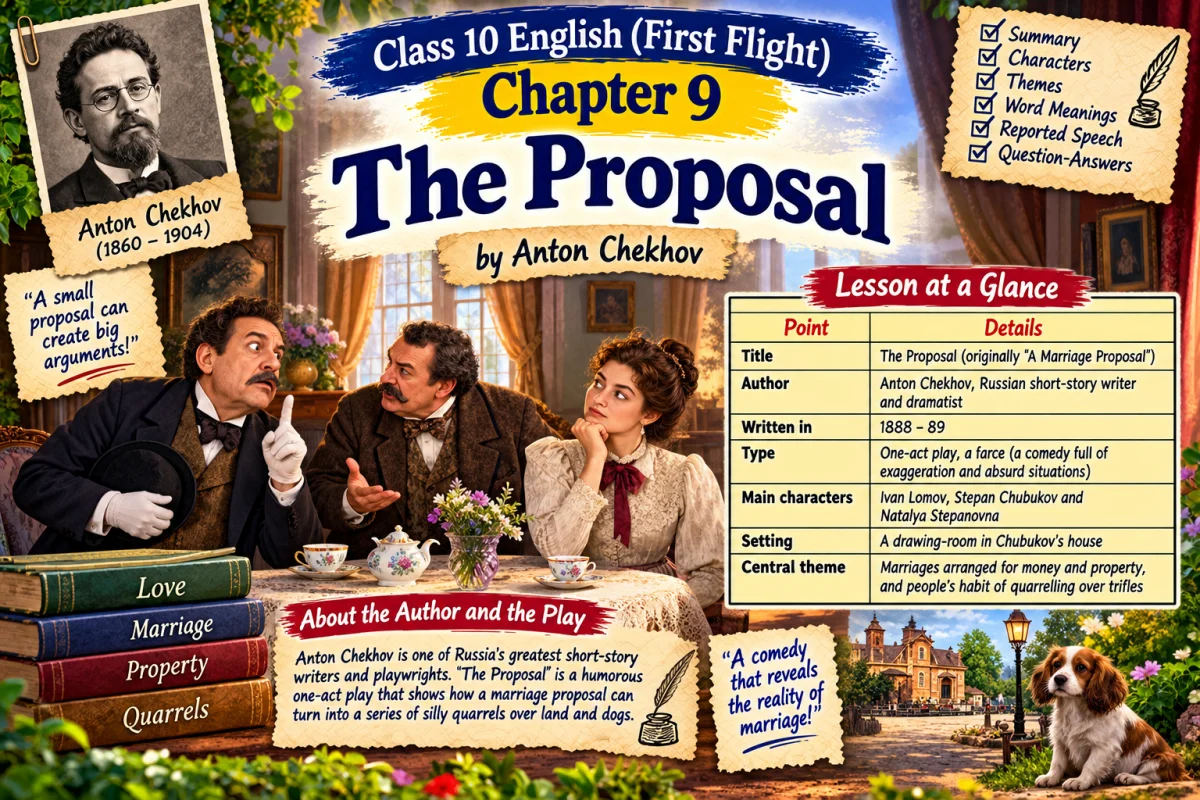
In the English textbook First Flight, the one-act play "The Proposal" by the Russian writer Anton Chekhov is a lively comedy about a marriage proposal that keeps getting lost in a series of silly quarrels. A nervous landowner comes to ask for a neighbour's daughter's hand in marriage, but instead of romance he ends up arguing about land and dogs. Below, the play is explained in simple language — background, summary, characters, themes, word meanings, reported speech and exam-ready question-answers.
Lesson at a Glance
| Point | Details |
|---|---|
| Title | The Proposal (originally "A Marriage Proposal") |
| Author | Anton Chekhov, Russian short-story writer and dramatist |
| Written in | 1888–89 |
| Type | One-act play, a farce (a comedy full of exaggeration and absurd situations) |
| Main characters | Ivan Lomov, Stepan Chubukov and Natalya Stepanovna |
| Setting | A drawing-room in Chubukov's house |
| Central theme | Marriages arranged for money and property, and people's habit of quarrelling over trifles |
Class 10 English First Flight Chapter 9 The Proposal by Anton Chekhov summary, characters, word meanings and question answers for students.
About the Author and the Play
Anton Chekhov (1860–1904) is one of Russia's best-known short-story writers and playwrights. "The Proposal" is one of his short comic plays. It pokes fun at wealthy families who look for marriages that make good financial sense, so that their lands and estates grow bigger. In the play, the proposal is nearly forgotten because the three characters are too busy quarrelling, but in the end the practical benefits of the match win, even though the quarrelling goes on.
What is the "Before You Read" Russian wedding passage about?
The lesson begins with an article on Russian weddings, which can last two days or more. The groom has to answer difficult questions from the bride's friends at each landing as he climbs to her apartment. The newly-married couple then tours the city and attends a reception with toasts. Later, friends "steal" the bride and her shoe, and the groom has to pay to get them back. Students are asked to compare these customs with Indian weddings.
Summary of the Play
Scene 1 — An Unexpected Visitor
Ivan Lomov, a wealthy and very suspicious landowner, visits his neighbour Stepan Chubukov dressed in formal evening clothes and white gloves. Chubukov greets him warmly but wonders why he is so dressed up. Lomov is so nervous that he keeps drinking water. Chubukov secretly assumes that Lomov has come to borrow money and decides not to lend any. When Lomov finally blurts out that he wants to marry Chubukov's daughter Natalya, Chubukov is overjoyed, hugs him, and goes to call her.
Scene 2 — Lomov's Worries
Left alone, Lomov trembles with nerves. He tells himself that he must decide quickly, because if he thinks too long he will never marry. He feels Natalya is a good housekeeper, reasonably good-looking and well educated. He is already thirty-five, and his health is poor: he complains of palpitations, twitching eyebrows and disturbed sleep. Marriage, he believes, will give him a calm and regular life.
Scene 3 — The Quarrel over Oxen Meadows
Natalya enters, casually dressed, and chats about hay and the weather. When Lomov starts speaking about his family's long friendship with hers, he mentions "my Oxen Meadows". Natalya objects at once, saying the land is hers. Both of them argue about ownership, going back to grandparents and old documents. Their tempers rise and they begin shouting. Chubukov enters, takes his daughter's side, and the argument grows into a full fight in which they insult each other's families. Lomov's heart "palpitates", his foot goes numb, and he staggers out.
Scene 4 — The Realisation
Chubukov tells Natalya the truth: Lomov had come to propose to her. Natalya is horrified at having driven him away and, in hysterics, orders her father to bring him back. Chubukov blames her, she blames him, and he fetches Lomov.
Scene 5 — The Quarrel over the Dogs and the Ending
Natalya now agrees that the meadows belong to Lomov. They begin talking pleasantly, but soon start comparing their hunting dogs, Lomov's Guess and Natalya's Squeezer. A new argument starts, and Chubukov joins in again. The shouting becomes so heated that Lomov falls into a chair and seems to be dead. Natalya and Chubukov panic. When Lomov revives, Chubukov quickly joins the couple's hands and gives his blessing. They kiss and say they are happy, but within moments they are again disputing which dog is better. Chubukov calls for champagne as the curtain falls.
Characters
| Character | Description and nature |
|---|---|
| Ivan Vassilevitch Lomov | A large, hearty but very suspicious landowner of thirty-five; nervous, hypochondriac (always worried about his health), stubborn and quick to take offence |
| Stepan Stepanovitch Chubukov | A landowner and Natalya's father; hot-tempered, boastful, money-minded and two-faced in his behaviour |
| Natalya Stepanovna | Chubukov's twenty-five-year-old daughter; practical, proud, argumentative and unwilling to give in |
Themes and Message
- Marriage and money: the match is attractive because it joins two neighbouring landed families, not because of love.
- Pride and ego: the characters would rather win an argument than keep peace, even when the issue is tiny.
- Satire on the upper class: Chekhov makes fun of landowners who care about land, dogs and status above all else.
- Anger and its cost: uncontrolled temper nearly destroys the proposal and harms the characters' health.
- Humour through exaggeration: sudden changes of mood, fake illnesses and ridiculous insults create the comedy of a farce.
Important Word Meanings
| Word | Simple meaning |
|---|---|
| farce | a comedy with exaggerated and silly situations |
| aside | words spoken by an actor that the other characters are supposed not to hear |
| palpitations | a fast or irregular heartbeat |
| implore | to beg earnestly |
| consent | agreement or permission |
| pedigree | the recorded family line of an animal |
| thoroughbred | an animal of pure breed |
| overshot | having a lower jaw shorter than the upper (in the play, taken as a fault in a dog) |
| malicious | wishing to harm others |
| intriguer | a person who makes secret, cunning plans |
| pettifogger | a person who raises petty legal arguments |
| embezzlement | dishonestly taking money entrusted to one's care |
| impudent | rude and disrespectful |
| accustomed | used to something |
| temporary | lasting for a short time only |
Language Focus: Reported Speech
This lesson also teaches reported (indirect) speech. A sentence in reported speech has a reporting clause (for example, Mamta said) and a reported clause (what was said). Here are the main rules, based on the textbook exercise:
| Rule | Answer |
|---|---|
| Reporting verb for a question | asked |
| Reporting verb for a statement | said (or told, declared) |
| The adverb here changes to | there |
| Present tense in direct speech becomes | past tense |
| Present continuous becomes | past continuous (for example, is getting becomes was getting) |
| A respectful word in direct speech adds this adverb | respectfully |
| First-person pronouns (I, me, our, mine) change to | he, she, him, her, his, their, etc., depending on the speaker or listener |
Key Points for Exams
- "The Proposal" is a one-act farce by Anton Chekhov, written in 1888–89.
- Lomov comes in formal dress to ask for Natalya's hand; Chubukov first thinks he has come to borrow money.
- The first quarrel is about who owns the Oxen Meadows.
- The second quarrel is about whose hunting dog, Guess or Squeezer, is better.
- Lomov repeatedly complains of palpitations, a numb foot and twitching eyebrows when he gets upset.
- Natalya becomes hysterical only after she learns that Lomov had come to propose.
- Chubukov joins their hands when Lomov revives, and calls for champagne.
- The play ends with the couple quarrelling again, which keeps the comic mood alive.
What Do We Learn from this Play?
The play shows how foolish it is to let pride and temper spoil important moments. It also makes us think about marriages based on property and convenience rather than understanding. Above all, Chekhov uses laughter to remind us that small arguments should not be allowed to become big quarrels.
The Proposal — Questions and Answers
Question 1: What does Chubukov at first suspect that Lomov has come for? Is he sincere when he later says he has always loved him as his own son?
Answer: Chubukov first thinks that Lomov has come to borrow money, and he decides in an aside that he will not lend any. When he learns that Lomov wants to marry Natalya, he suddenly becomes affectionate, kisses him and speaks of loving him like a son. This does not seem sincere. His joy comes from the benefit of the match, and when the quarrel starts he quickly insults Lomov, calls him many names and throws him out of the house.
Question 2: Chubukov says Natalya is "in love" and "like a lovesick cat". Would you agree?
Answer: No, this does not seem true. Natalya shows no sign of love for Lomov. She greets him casually, talks about peas and hay, and quarrels with him within minutes. She does not even know why he has come. Only when she learns that he came to propose does she become desperate to call him back, which suggests that she is keen on marriage and on the advantage it brings, rather than being truly in love.
Question 3 (i): What words and insults do the characters use for each other?
Answer: Chubukov calls Lomov names such as pettifogger, intriguer, scarecrow, villain, blind hen, milksop and old rat. He also insults Lomov's family by calling them mad and dishonest. Lomov calls Chubukov a grabber and an intriguer, and Natalya describes Lomov as a rascal and a monster. Yet at the start, Lomov described Natalya as a good housekeeper, and Chubukov addressed Lomov with sweet words like "my angel" and "my darling".
Question 3 (ii): Suggest adjectives to describe each character.
Answer:
- Lomov: nervous, suspicious, hypochondriac, stubborn, excitable.
- Chubukov: hot-tempered, hypocritical, greedy, loud, over-dramatic.
- Natalya: proud, practical, quarrelsome, quick-tempered, opportunistic.
Question 3 (iii): What might these characters quarrel about next?
Answer: They may argue about household matters, such as who should manage the estate, how money should be spent, or whose relatives should be invited to the wedding. They may also continue to dispute the merits of their dogs, or whose family has the better name.
Question 4 (Extra): Why does Lomov dress in formal clothes, and why does it surprise the others?
Answer: Lomov dresses formally because he is about to make an important proposal and wants to make a good impression. Both Chubukov and Natalya are surprised because it is an ordinary afternoon and nobody expects such dress. Chubukov even wonders whether he is going to a party.
Question 5 (Extra): Why is Lomov in a hurry to marry?
Answer: Lomov feels that at thirty-five he has reached a "critical age" and that his poor health needs a calm and regular life. He also thinks that Natalya has all the qualities he needs, and fears that if he waits or looks for ideal love, he may never marry.
Question 6 (Extra): Why is "The Proposal" called a farce?
Answer: A farce is a comedy that uses exaggeration and absurd situations. In this play, the characters quarrel loudly over small things, Lomov seems to be dying and then suddenly recovers, and the couple begins fighting again within seconds of agreeing to marry. These improbable events create humour.
Question 7 (Extra): How does the play end, and what does the ending suggest?
Answer: After Lomov revives, Chubukov joins the couple's hands and blesses them. They are happy for a moment, but immediately start arguing again about their dogs, while Chubukov tries to shout over them and calls for champagne. The ending suggests that quarrelling is part of their nature and that their married life will probably be as noisy as their courtship.
The Whole Play in a Nutshell
In "The Proposal", Lomov arrives at Chubukov's house to ask for Natalya's hand, but his nervousness and pride lead to two big quarrels, first over the Oxen Meadows and then over their dogs. Chubukov and Natalya shout insults at him, and Lomov collapses. Once they realise the proposal is at stake, they bring him back, and the marriage is settled in a hurry, only for the arguing to start again. The central message is that pride, temper and greed for property can make people behave foolishly, even in the most important moments of life. In exams, questions are usually asked on the characters, the causes of the quarrels, Chubukov's real motives, the meaning of farce and the ending of the play.
For more exam preparation, you can also read our Class 9 Geography Chapter 2 notes and Class 9 Science notes on Matter in Our Surroundings. If you want to order NCERT books online, see our step-by-step guide to ordering NCERT books at home, and explore our list of free AI and scientific tools for Class 6 to 12 students. For the official textbooks and syllabus, visit the official NCERT website.
Frequently Asked Questions

Vivek Kumar is an Editorial Intern at Aapbiti, specializing in publishing and managing education-focused news articles. Operating under the direct mentorship and guidance of Shakti Rao Mani, the Product Owner of aapbiti.com, Vivek is dedicated to delivering accurate, timely, and engaging academic updates. His role focuses on keeping readers informed about educational trends, exams, admissions, and key academic policies.





Comments (0)